 yuanming@yuanming.com.cn
  86-755-89703008
2-Part vs 3-Part Carbonless Forms: How to Choose
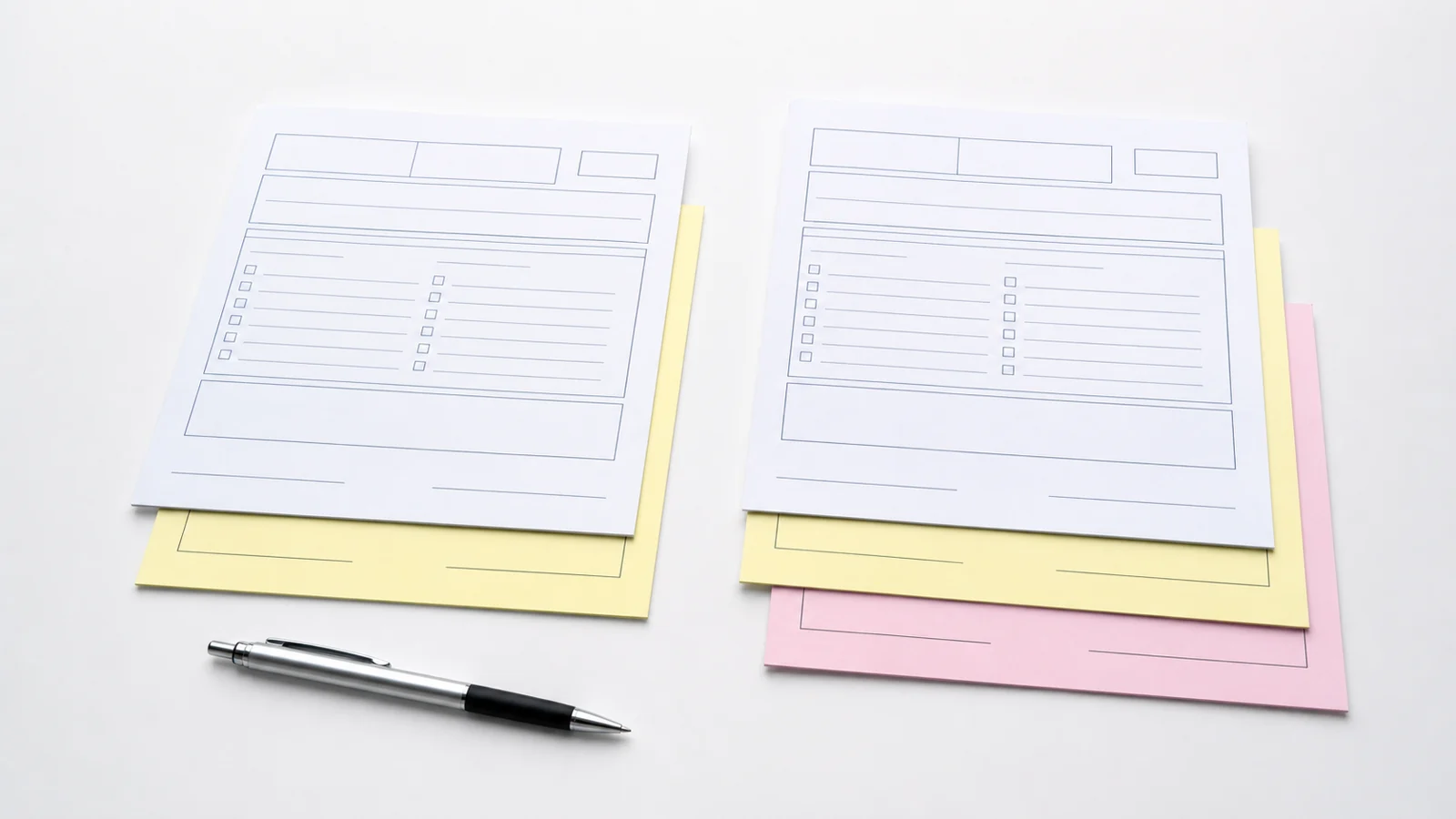
Choosing between 2-part vs 3-part carbonless forms is mainly a workflow decision. Use a 2-part form when two people or departments need matching records. Use a 3-part form when three recipients need a copy—for example, the customer, a field technician, and the office.
The extra sheet is useful only when it has a clear owner. Before ordering, list who needs a copy, when they receive it, and where it will be stored. That simple exercise usually reveals the right part count.
Key Takeaways
- Choose by the number of people who need an immediate paper record, not by assuming that more copies are better.
- A 2-part set creates one original and one copy; a 3-part set creates one original and two copies.
- Give every sheet a named recipient before approving the form layout.
- Confirm color sequence, numbering, perforation, binding, quantity, and artwork as separate ordering decisions.
What Does “Part” Mean?
In carbonless printing, a “part” is one sheet in a collated form set. Writing or impact pressure on the top sheet produces the same information on the sheet or sheets below without inserting loose carbon paper.
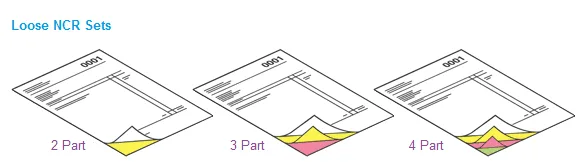
- A 2-part set contains one original and one duplicate copy.
- A 3-part set contains one original and two duplicate copies.
The copy is created by interacting coatings. The top sheet is commonly called CB (coated back), the last sheet CF (coated front), and a middle sheet in a 3-part or larger set CFB (coated front and back). Paper manufacturer Koehler Paper explains the coating sequence and how writing pressure creates the image on the next sheet.
Compare 2-Part and 3-Part Forms
| Decision point | 2-part form | 3-part form |
|---|---|---|
| Records produced | Original + 1 copy | Original + 2 copies |
| Best fit | Two-recipient workflow | Three-recipient workflow |
| Typical routing | Customer + office | Customer + field staff + office |
| Common examples | Simple receipts, basic invoices, estimates | Work orders, delivery notes, purchase orders, service records |
| Handling | Fewer sheets to separate and file | One additional sheet to route and store |
| Main risk | A third stakeholder has no immediate copy | The extra copy has no defined purpose |
The deciding question is not “Which version is better?” It is “How many separate records must exist immediately after the form is completed?”
When 2-Part Forms Are Enough
Choose a 2-part form when one copy leaves with the customer and one stays with your business. This is usually the simplest option for a direct transaction involving only two record holders.
- a customer receipt retained by the customer and the seller;
- a service estimate retained by the customer and contractor;
- a basic invoice retained by the buyer and accounts office;
- a simple delivery acknowledgement retained by the receiver and driver.
This setup works well only if the business copy reliably reaches the person who files, bills, or reviews it. If a technician keeps the second sheet but the office also needs an immediate paper record, a 2-part set creates a handoff problem. That workflow probably needs a third part.
When to Choose a 3-Part Form
Choose a 3-part form when three parties need the same written information at the end of the transaction. The third sheet is especially useful when work happens away from the main office.
- the customer receives the original;
- the technician keeps one copy for the job record;
- the office receives one copy for invoicing or filing.
Other possible workflows include receiver, driver, and dispatch office for a delivery note; vendor, receiving team, and accounting for a purchase order; customer, server or cashier, and manager for a manually recorded transaction; or site contact, subcontractor, and project office for a work authorization.
Do not add a third part merely “in case” someone might need it. Give every sheet a named recipient and a retention purpose. If nobody owns the third copy, it adds unnecessary separation, filing, and storage.
Map Who Gets Each Copy
Use this four-step routing check before choosing the part count. Follow the form from the moment it is completed until every record reaches its final owner.

01Identify everyone who needs an immediate record
Count recipients, not departments that can access a shared record later. If the customer and office are the only immediate recipients, two parts may be enough. If a driver or technician must also retain a copy, consider three parts.
02Decide which copy must remain in the book
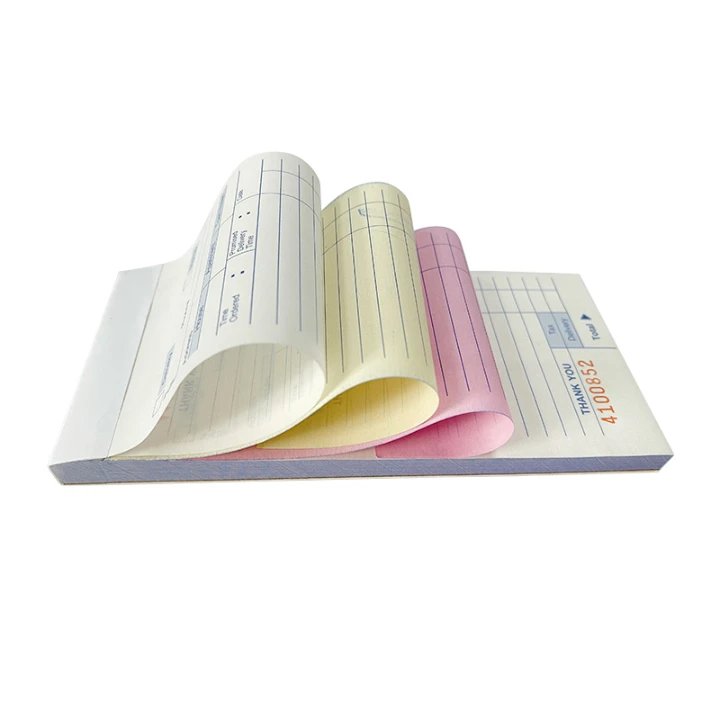
Some businesses want the final copy to stay bound as a permanent sequential record. Others use loose sets or tear out every sheet. Your binding and perforation specification should match that process.
03Check how the office receives completed paperwork
If field staff return paperwork at the end of every shift, two parts may still support the process. If the employee needs a personal job record while the office also needs a copy, three parts reduce later scanning or photocopying.
04Confirm whether a digital copy replaces a paper copy
A photographed or scanned form may replace one paper copy in some workflows. However, consider who performs the scan, when it occurs, and whether signatures or handwritten notes remain legible. Do not remove a paper part until the digital handoff is dependable.
Choose the Sheet Colors
White/yellow is a common sequence for 2-part sets, while white/yellow/pink is common for 3-part sets. These colors make the copies easier to identify, but they do not determine who must receive each sheet.
Assign copies according to your process, then label the form or train staff accordingly. Available paper colors and their order can vary by manufacturer, market, and production method, so confirm the required sequence during quotation instead of treating a common sequence as universal.
Other Specifications to Confirm
Part count is only one line in a complete carbonless-form specification. A useful quote request should also state:
- finished form size;
- loose sets, pads, or bound books;
- number of sets per pad or book;
- required sheet color sequence;
- sequential numbering and starting number;
- numbering position;
- perforation position and which sheets tear out;
- writing shield or wraparound cover requirement;
- print colors on the front and, if needed, the back;
- quantity;
- artwork status and required file changes;
- packing and delivery destination.
If you are still deciding on the form format, start with the Business Forms Printing overview. For application-specific planning, compare the requirements of work order forms, delivery note books, receipt books, and invoice books.
Common Ordering Mistakes
Most part-count problems come from unclear terminology or an undefined copy route. Check these five points before approving artwork.
Counting copies instead of sheets
Some buyers describe a 2-part set as “one original and two copies.” That is actually three sheets and normally requires a 3-part set. State both the total number of sheets and the intended recipients.
Leaving the third copy without an owner
An unused copy wastes time and creates inconsistent filing. Name the recipient of every part before approving artwork.
Assuming the color order is fixed
White/yellow and white/yellow/pink are common, but availability varies. Put the exact sequence in the specification and proof.
Forgetting numbering, perforation, or a writing shield
These finishing details often determine whether the form works smoothly in the field. Review the complete physical workflow, not just the printed design.
Approving content without testing the form
Check that important fields, signatures, and handwriting areas remain usable across the full set. A production proof should confirm layout, numbering position, copy labels, and finishing instructions.
The Simple Decision Rule
Use 2-part carbonless forms when exactly two recipients need matching paper records. Use 3-part carbonless forms when exactly three recipients need them. If the count is unclear, draw the path of the form from the moment it is written to the moment every copy is filed.
Once the routing is clear, prepare the size, color sequence, numbering, perforation, binding, quantity, and artwork details. You can then contact PrintingMaxx with a complete specification for review and quotation.
FAQs
Open a question for a concise answer. These points clarify terminology and ordering choices that buyers commonly check after comparing the part count.
Is a 2-part form the same as a duplicate form?
Yes. A 2-part set contains an original and one duplicate sheet. Always confirm the total sheet count when requesting a quote.
Is a 3-part form the same as a triplicate form?
Yes. A 3-part set contains an original and two copy sheets, producing three matching records from one written entry.
Are 3-part carbonless forms better than 2-part forms?
Not automatically. Three parts are appropriate only when three recipients need a paper record. For a two-recipient workflow, the additional sheet may add unnecessary handling and storage.
Can I choose a different color sequence?
Possibly. White/yellow and white/yellow/pink are common sequences, but actual options depend on available stock and production requirements. Specify the desired order and ask the printer to confirm it.
Should the last copy remain bound in the book?
That depends on your recordkeeping process. A retained copy can support sequential filing and traceability, while fully removable sets may be more convenient for distribution. Specify perforations and binding during quotation.