 yuanming@yuanming.com.cn
  86-755-89703008
NCR Books vs Pads vs Loose Sets: Which Format Fits Your Workflow?

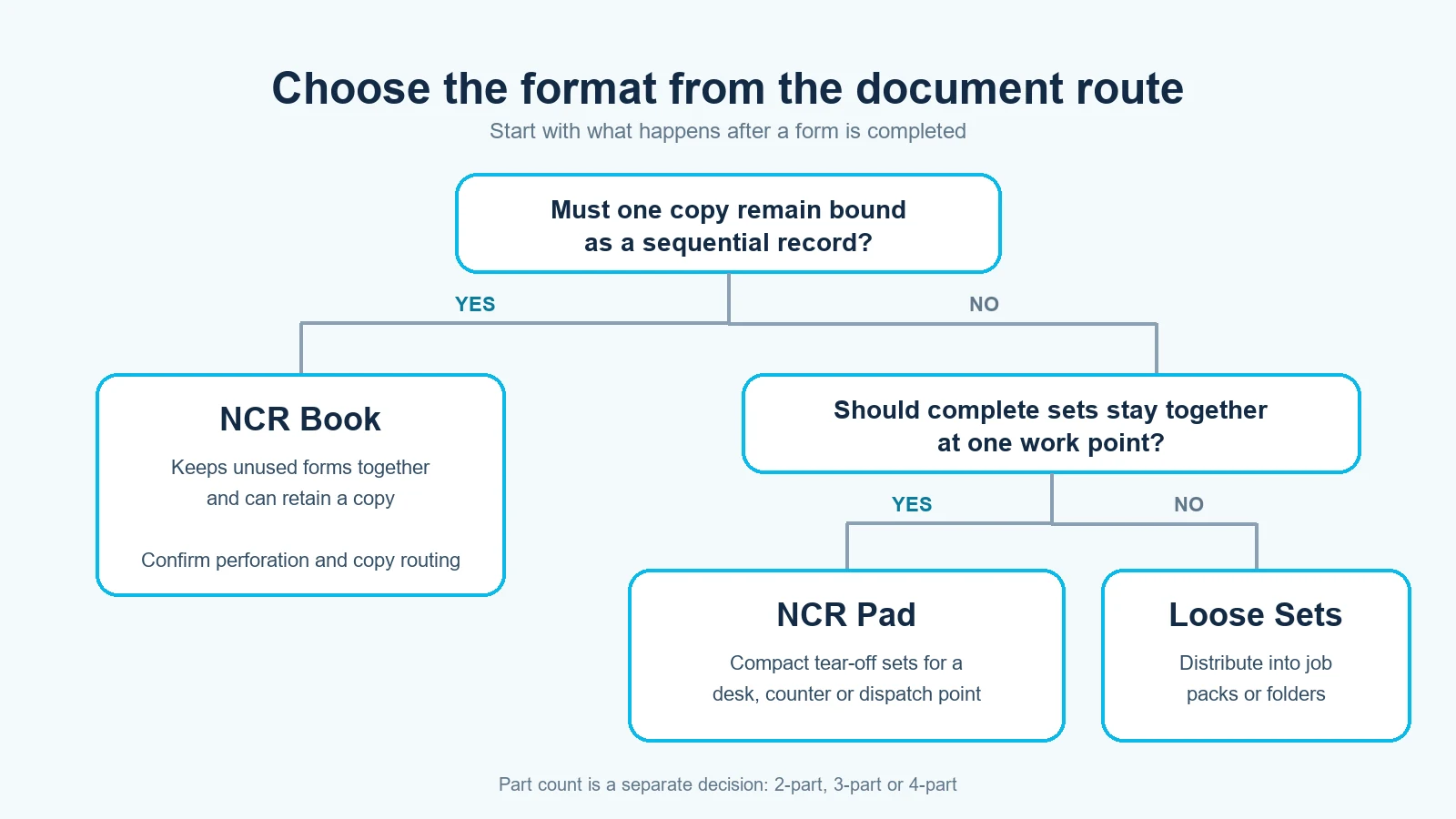
Choosing among NCR books vs pads vs loose sets becomes clearer when you follow one form from issue to archive. Choose an NCR book when unused forms must stay protected and a copy may need to remain bound. Choose an NCR pad when complete sets are used from one compact stack. Choose loose NCR sets when individual forms must be distributed into job packs, folders or different locations.
Part count is a separate decision. “Three-part” describes the three sheets in one multipart set; it does not tell the printer whether those sets should be bound, padded or supplied loose.
Follow One Form
Imagine a service form issued at the start of a shift. A technician completes it at a customer site, gives one copy to the customer, and returns another copy to the office. Before choosing a format, trace four moments:
- Issue: Who receives the blank form?
- Complete: Where is it written on?
- Separate: Who receives each copy immediately?
- Archive: Does any copy stay in a book, or does every sheet move elsewhere?
This route matters more than the product name. A book, pad or loose set is useful only when it removes handling from that route.
Does a Copy Stay Bound?
If one copy must remain in sequence after the other copies are removed, start by discussing an NCR book. The binding keeps unused forms together, and the perforation pattern can be planned so selected sheets leave while another sheet stays.
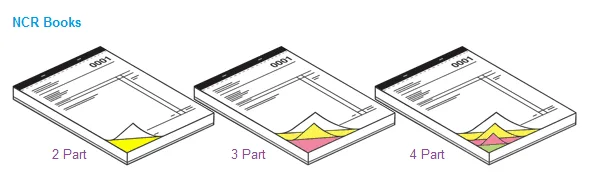
This behavior is not automatic. State which copy the customer receives, which copy returns to the office, and which copy, if any, remains bound. The perforation must match that routing.
NCR books often suit mobile service work, numbered delivery records and other processes where blank forms must travel together. A multipart work order form may use this structure when a technician carries one controlled book between jobs.
One Work Point or Many?
If no copy needs to remain bound, ask where the blank forms wait before use.
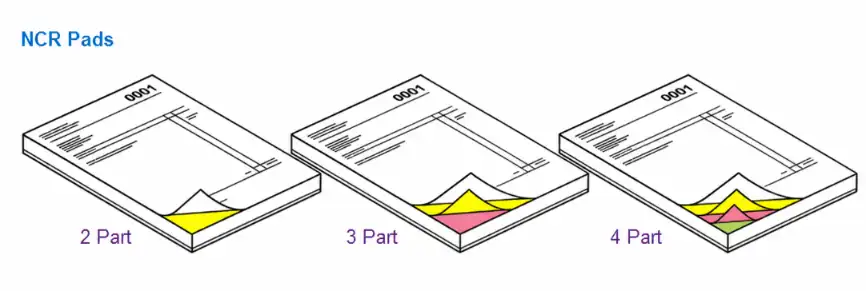
An NCR pad suits a counter, desk or dispatch point where users want a compact stack and remove one complete multipart set at a time. After writing, the whole set leaves the pad, and its sheets are separated for distribution or filing.
Loose NCR sets make more sense when blank forms are allocated before use. A warehouse may place one set in each shipment folder; a service coordinator may add one to every job pack; multiple branches may receive separate batches.

- Pad: several complete sets stay together until one is needed.
- Loose sets: each complete set can be assigned, packed or filed separately before use.
Loose sets need their own protection and sequence control. Folders, envelopes, labelled job packs or sequential numbering may support that process.
NCR Books vs Pads vs Loose Sets
| Workflow question | NCR book | NCR pad | Loose NCR sets |
|---|---|---|---|
| Do unused forms stay together? | Yes, in a bound unit | Yes, in a glued stack | Only if your own folder or pack keeps them together |
| Can one copy remain bound? | Possible when construction and perforation are specified | Not the normal reason to choose a pad | No bound archive |
| How is a completed form removed? | Copies tear out according to the specified pattern | The complete set is removed from the pad | The set is already separate |
| Where does it work well? | Vehicles, field kits and controlled sequential records | Counters, desks and dispatch points | Job folders, shipment packs and distributed teams |
| What needs particular attention? | Retained copy, perforation, cover and writing shield | Glued edge, sets per pad, backing and removal | Packing, protection, numbering and issue control |
These are decision guidelines, not universal construction promises. Available covers, set counts, perforations and binding details must be confirmed for the actual size, part count, quantity and production method. Paper manufacturer Domtar identifies multipart business forms, invoices, packing slips and shipping documents as carbonless-paper applications, but the finished format still has to match the way each document is handled.
Specify What Happens Next
The format should describe the next physical action after the form is completed.
For a book, write: “Customer and driver copies tear out; office copy remains bound.” For a pad, write: “Remove the complete three-part set, then separate copies for customer, dispatch and accounts.” For loose sets, write: “Pack one numbered set with each delivery file before dispatch.”
That wording is more reliable than asking only for “duplicate books” or “triplicate pads.” It tells the printer what the document must do.
- which edge is bound or glued;
- where perforation is positioned;
- whether a cover, backing board or writing shield is needed;
- whether every part carries the same sequential number;
- how completed copies will be filed.
When the form travels with goods, delivery note books may provide a useful reference point, but the finished construction still needs to match the copy route.
Avoid Format Mismatches
Choosing a book by habit. A book adds control only when bound protection or a retained record is useful. If every completed set immediately moves into separate folders, a pad or loose sets may remove an unnecessary step.
Confusing parts with format. A three-part set contains three sheets. The same part count does not automatically determine whether the sets are supplied as books, pads or loose forms.
Assuming the last copy stays in the book. Retention depends on construction and perforation. Put the required behavior in writing.
Also check where blank forms wait and how numbering works. A pad is convenient at one work point; loose sets may be easier when forms are distributed before use. When traceability matters, specify the starting number, number of digits and whether the same number appears on every part.
Build the Quote Specification
Prepare the document route before requesting a quotation:
- finished size and orientation;
- number of parts in each set;
- sheet color sequence;
- owner of every copy;
- book, pad or loose-set format;
- sets per book or pad, when applicable;
- binding or glued edge;
- perforation and retained-copy instructions;
- sequential numbering requirements;
- cover, backing board or writing shield;
- artwork status;
- total quantity and delivery destination.
The right choice among NCR books vs pads vs loose sets is the format that makes issuing, writing, separating and filing the form simpler. PrintingMaxx supplies custom carbonless business forms for different workflows. When the route and specification are ready, contact PrintingMaxx for production review and quotation.