 yuanming@yuanming.com.cn
  86-755-89703008
How to Choose Paper for Custom Notepads

The best paper for custom notepads is the paper that works with the pens, page design and handling conditions your team actually uses. Do not choose from weight alone. Ask for available samples, print your real layout, write on each sheet with common tools, then check drying, show-through and tear-off behavior.
That short test turns an abstract paper specification into a purchasing decision. It also gives a printer clearer information than a request for “standard notepad paper.”
Start with the Writing Job
Before comparing stocks, describe what happens to one sheet. Is it a quick phone-message slip, a delivery checklist, a desk memo or a branded leave-behind? Will someone write on a hard counter, carry the pad in a vehicle or keep it beside a computer?
Record four facts: who writes, which tool they use, whether the back must remain clean, and how long the note needs to last. A disposable checklist and a client-facing estimate may look similar on screen but place different demands on the paper.
This step also prevents a common purchasing mistake: selecting a premium-feeling sheet that is slower to write on or unnecessarily expensive for a short-lived note.
Test the Pens People Use
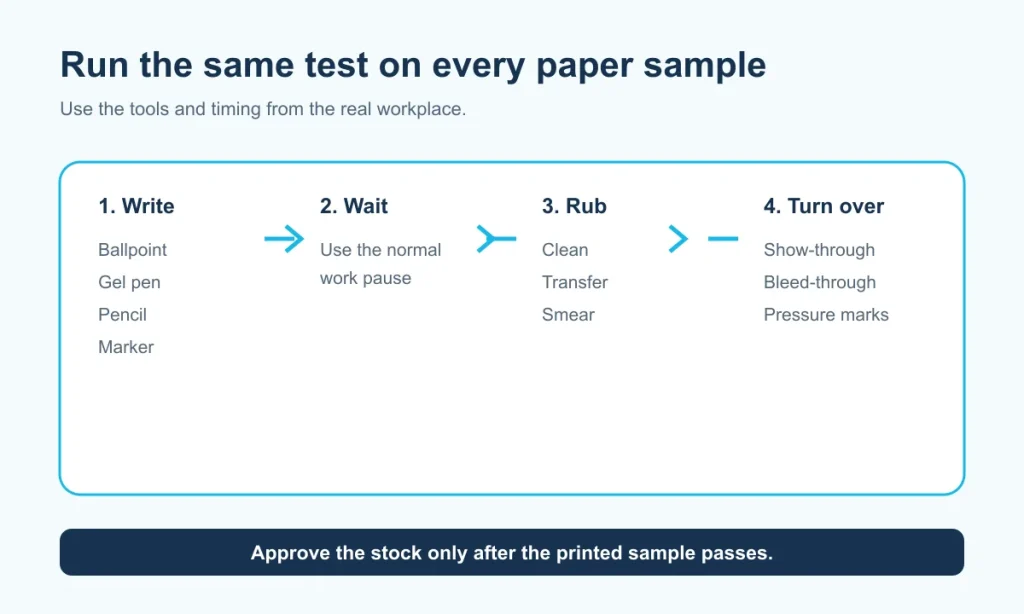
Use the real tools from the workplace—not one convenient office pen. A useful test set for many U.S. offices includes a ballpoint, gel pen, pencil and permanent marker. If the team uses felt-tip pens, stamps or highlighters, add those too.
Write the same short lines and check:
- how easily the tip starts and moves;
- whether ink feathers around fine strokes;
- whether fresh writing smears when a hand passes over it;
- whether pressure leaves a strong impression on sheets below;
- whether marks are easy to read under normal office lighting.
Keep the test practical. You are comparing available production samples for one job, not trying to declare a universal winner.
Choose Paper for Custom Notepads
Paper weight is useful, but the number needs context. In the United States, paper is often described by basis weight; international specifications commonly use grams per square meter. TAPPI explains that basis weight depends on a defined basic sheet size, while ISO 536 provides a method for determining grammage. Two numbers therefore should not be compared casually without knowing the paper grade and measurement basis.
For purchasing, use weight as a screening detail and the physical sample as the decision tool. A lighter available sheet may be right for high-volume internal notes. A more substantial sheet may feel more appropriate for client-facing forms or pages with heavier ink coverage. Neither conclusion should be made before testing the exact stock offered for the job.
Ask the printer for two or three available candidates rather than requesting a weight that may not match the intended performance. PrintingMaxx’s custom notebook and notepad printing service can be specified by finished size, page layout, color, binding or padding details, and packaging; current material options should be confirmed during quotation.
Check Show-Through and Drying
Turn the sheet over after each pen test. Show-through can make a one-sided note look less clean, even when no ink has physically bled through. It becomes more noticeable when the page has dark branding, fine rules or writing on both sides.
Then time the practical drying interval. You do not need laboratory equipment: write, wait the amount of time a user normally pauses, and rub a clean finger or scrap sheet across the line. Record “clean,” “slight transfer” or “smear.” Repeat the test rather than relying on a single mark.
If employees are left-handed or write quickly, include them in the sample review. Their experience may reveal a problem that a slow, right-handed test misses.
Match Paper to Page Design
Paper and artwork should be reviewed together. Large solid-color areas can change the perceived surface and may show variation more readily than a light logo with rules. Small type and fine checkboxes need enough contrast to remain legible after writing is added.
Use a production-size proof with the real header, line spacing, checkboxes and footer. Do not judge only from a blank paper swatch. If a note must be scanned, photographed or filed, test that step too.
Leave comfortable writing zones. A visually dense design may look polished on screen but force employees to write over color, rules or promotional copy. The best page usually makes the primary task obvious within a second.
Test the Finished Pad
A loose sheet cannot show everything. The finished sample should also be tested for support, sheet removal and everyday handling.
Write on the first, middle and last usable sheets. Check whether the backing supports writing on a counter and whether adhesive or padding remains stable during normal use. Tear off several sheets at different speeds and look for curling, rough edges or sheets releasing together.
If pads will be distributed to multiple locations, pack and handle a small sample as staff would. This connects the paper decision to the real workflow instead of treating it as a showroom choice.
Build a Sample Request
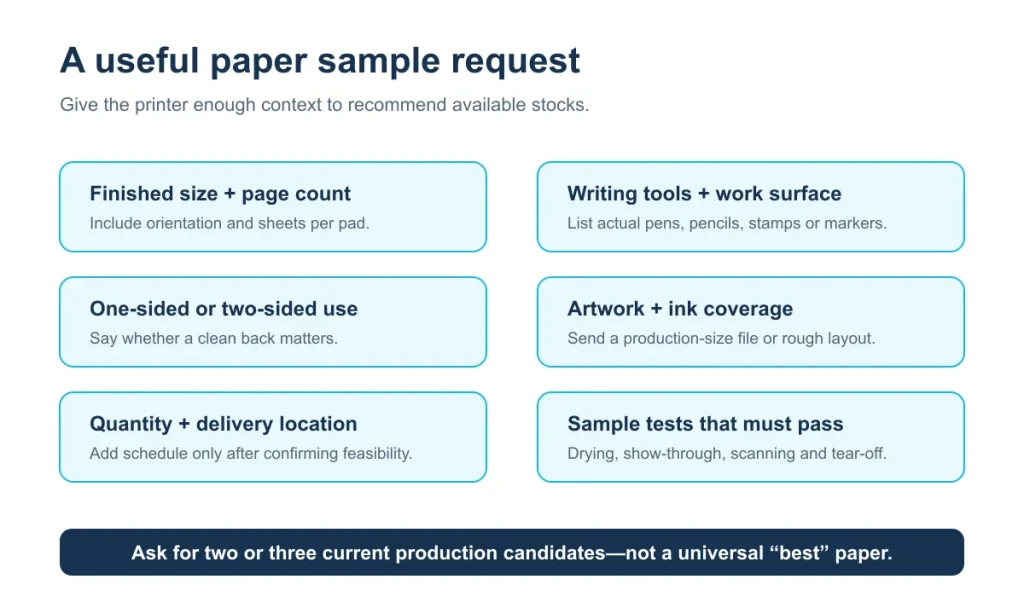
Send a concise request that a supplier can act on:
- finished pad size and orientation;
- intended use and work environment;
- one-sided or two-sided printing;
- page count per pad and estimated order quantity;
- colors and approximate ink coverage;
- pens, pencils, markers or stamps to be used;
- whether clean backs, scanning or long-term filing matter;
- delivery location and target schedule;
- artwork file, rough layout or physical sample.
Ask which available stocks the printer recommends for testing and why. Domtar similarly advises looking beyond a specification sheet because measured properties alone do not guarantee how paper will perform in a particular application.
Once you have tested the samples, send your results with the quote request. If you need help translating a rough layout into production questions, contact PrintingMaxx with the use case and artwork you have available.
Notepad Paper FAQs
Is heavier paper always better for a notepad?
No. A heavier sheet may feel more substantial, but it can add cost and bulk without improving a short-lived note. Compare available samples using the actual pens, print coverage and handling routine.
Should I specify basis weight or g/m²?
Use the measurement shown by the supplier and ask for the exact paper grade and a physical sample. Basis weight and g/m² describe weight through different conventions; a number without its context is not a complete buying specification.
Can I print on both sides of a notepad sheet?
It may be possible, but the paper, opacity, artwork and writing tools must be tested together. Confirm current production options and review a proof before ordering.
What should I send with a quote request?
Send finished size, page count, quantity, artwork, colors, writing tools, use environment, delivery location and any sample-test requirements. If you only have a sketch, include it and identify what still needs confirmation.
Make the Decision from Evidence
The right paper for custom notepads is not a marketing adjective or a single weight. It is the available stock that passes your real writing, visibility, artwork and tear-off tests at an acceptable total cost. Start with the work the note must do, compare physical samples, and document the result before approving production.
External references: ISO 536:2019, TAPPI/ANSI T 410, and Domtar: Five Tips for Looking Beyond Paper Specifications.