 yuanming@yuanming.com.cn
  86-755-89703008
2026 Print Buying Trends: 5 Smart Changes for Small Businesses

The most useful response to 2026 print buying trends is not simply to order less or demand a faster turnaround. Small businesses should decide critical specifications earlier, separate fixed details from changeable details, give one person authority to approve the proof, and keep a reusable record for the next order.
That approach addresses the tension visible in current industry data: buyers want shorter runs and faster job turns, yet many are taking longer to commit and are more sensitive to price. A rushed order with an unfinished brief is therefore the wrong shortcut. A reorder-ready process creates real flexibility.
What 2026 Print Buying Trends Show
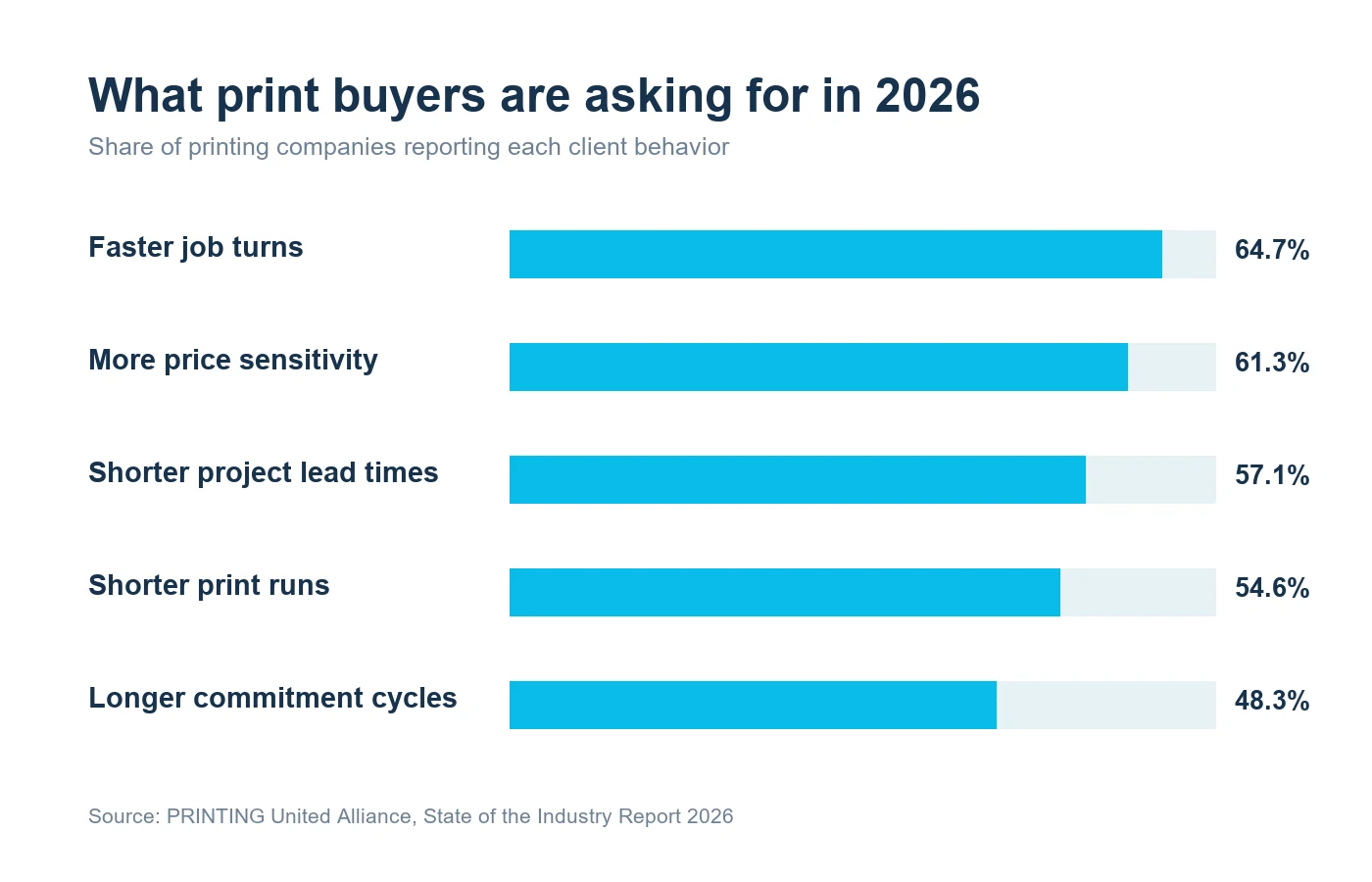
The PRINTING United Alliance State of the Industry Report 2026 summarizes responses from 258 printing companies across commercial printing, wide-format graphics, packaging and labels, and apparel decoration. Asked about client behavior, 64.7% reported requests for faster job turns, 61.3% reported greater price sensitivity, 57.1% reported shorter project lead times, 54.6% reported movement toward shorter runs, and 48.3% said clients were taking longer to commit.
These figures describe what participating printers observed among their clients; they are not a rule for every buyer or every print segment. Still, the combination is useful. It shows that many buyers are trying to preserve flexibility while expecting production to begin quickly after approval.
The Alliance’s Spring 2026 Print Buyer Report summary adds that organizations are placing more emphasis on measurable outcomes, workflow efficiency, automation and technology-enabled procurement. Intergraf’s Print Matters 2026 conference likewise emphasized changing customer expectations, automation, supply-chain pressure and resilience across Europe and North America.
For a small business, the practical lesson is simple: flexibility must be designed into the order before the deadline arrives.
Shorter Runs Change the Brief
A shorter run can reduce excess inventory when prices, contact details, locations or operating procedures may change. It can also support a pilot, a seasonal version or a new branch. But a smaller quantity does not remove the need to define the product correctly.
Before requesting a quote, separate the order into three groups:
| Group | Examples | Why it matters |
|---|---|---|
| Fixed | Finished size, binding edge, copy routing, essential fields | These choices define how the product works. |
| Variable | Date range, branch name, promotion, sequential number start | These details may change between versions or reorders. |
| Optional | Paper alternatives, finishing upgrades, packing format | These can be compared without reopening the whole brief. |
This method lets a printer quote the same functional product while showing alternatives clearly. It also makes version changes easier to control.
The principle applies across products. A multi-part form needs a defined copy route. A notebook needs a retained-page purpose. A restaurant paper item needs a finished size and a clear use at the table or counter. Quantity is important, but it sits on top of these decisions rather than replacing them.
Faster Turns Need Earlier Decisions
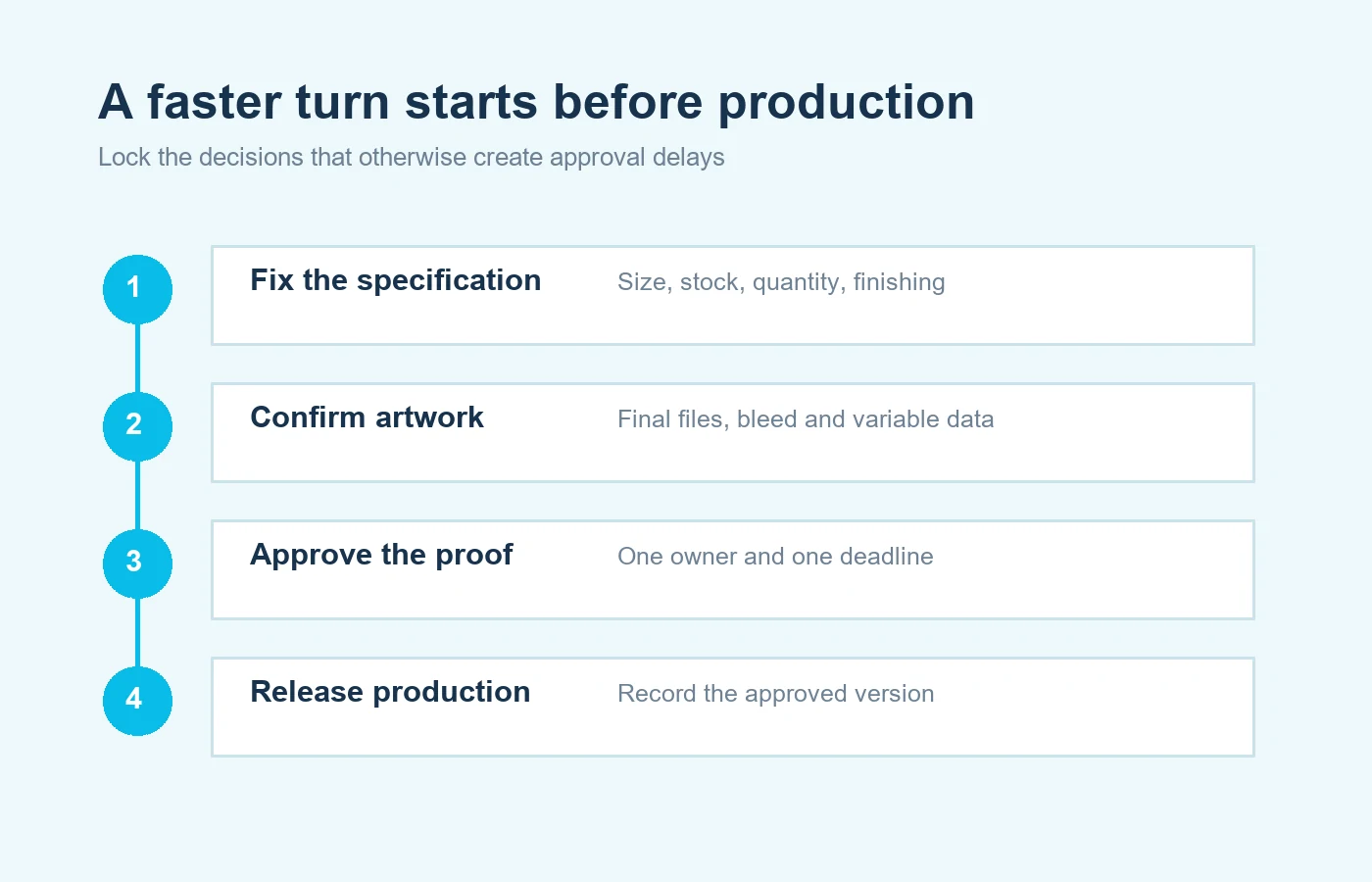
Fast production and late internal decisions are different problems. A printer can only work from the approved artwork and specification it receives. If several people can change the logo, wording, paper, size or delivery information after proofing begins, the apparent lead time becomes approval time.
Create a short internal approval path before sending files:
- The user confirms function. The person who uses the item checks fields, writing space and handling.
- The brand owner confirms content. One person checks logo, colors, names and public-facing wording.
- The buyer confirms specification. Purchasing verifies quantity, paper, finishing, packing and destination.
- One approver releases the proof. The printer receives one consolidated decision rather than conflicting messages.
Do not treat this as extra bureaucracy. Four clear owners are usually faster than an open email thread in which no one knows who can approve the final file.
Price Pressure Rewards Clear Quotes
Greater price sensitivity does not mean every order should use the cheapest visible option. It means comparisons need to be like for like. Two quotes can differ because they assume different paper, copy parts, sizes, finishing, packing or delivery terms.
Use the same written specification for every quote and ask suppliers to identify substitutions. Compare:
- finished size and orientation;
- paper or paper alternatives;
- number of designs or versions;
- printing colors and coverage;
- NCR parts, ruling or page count where relevant;
- binding, gluing, perforation or numbering;
- sets, sheets or pages per finished unit;
- packing, proof method, destination and requested date.
A lower-cost alternative can be valuable when it preserves the job’s function. It is not equivalent when it removes a required copy, makes a writing area too small or changes the way employees file completed records.
Connect Print to Digital Workflows
Current buyer research describes print as part of a broader communications and operating system, not an isolated purchase. Small businesses can apply that idea without adding complex technology to every page.
Start by deciding what the printed item should do after someone writes on it. Should a completed form be filed, scanned, handed to a customer or entered into software? Should a notebook remain with one employee? Should a restaurant item be discarded after one use or retained as a transaction record?
Then design the handoff. A clear job number can help office staff match a paper work order to a digital record. A stable version code can prevent an old form from being reordered. A location or department label can make packed items easier to distribute. If a barcode or QR code is genuinely required, confirm the data, destination, size and test method with the relevant system provider before approving artwork; do not add one merely because it is fashionable.
This is where the right product path matters. PrintingMaxx’s custom business forms support workflows that require structured handwritten records, while custom notebook printing suits retained notes and branded internal materials. Restaurants can start from the restaurant paper printing category and match the item to the actual service environment.
Build a Reorder-Ready Record
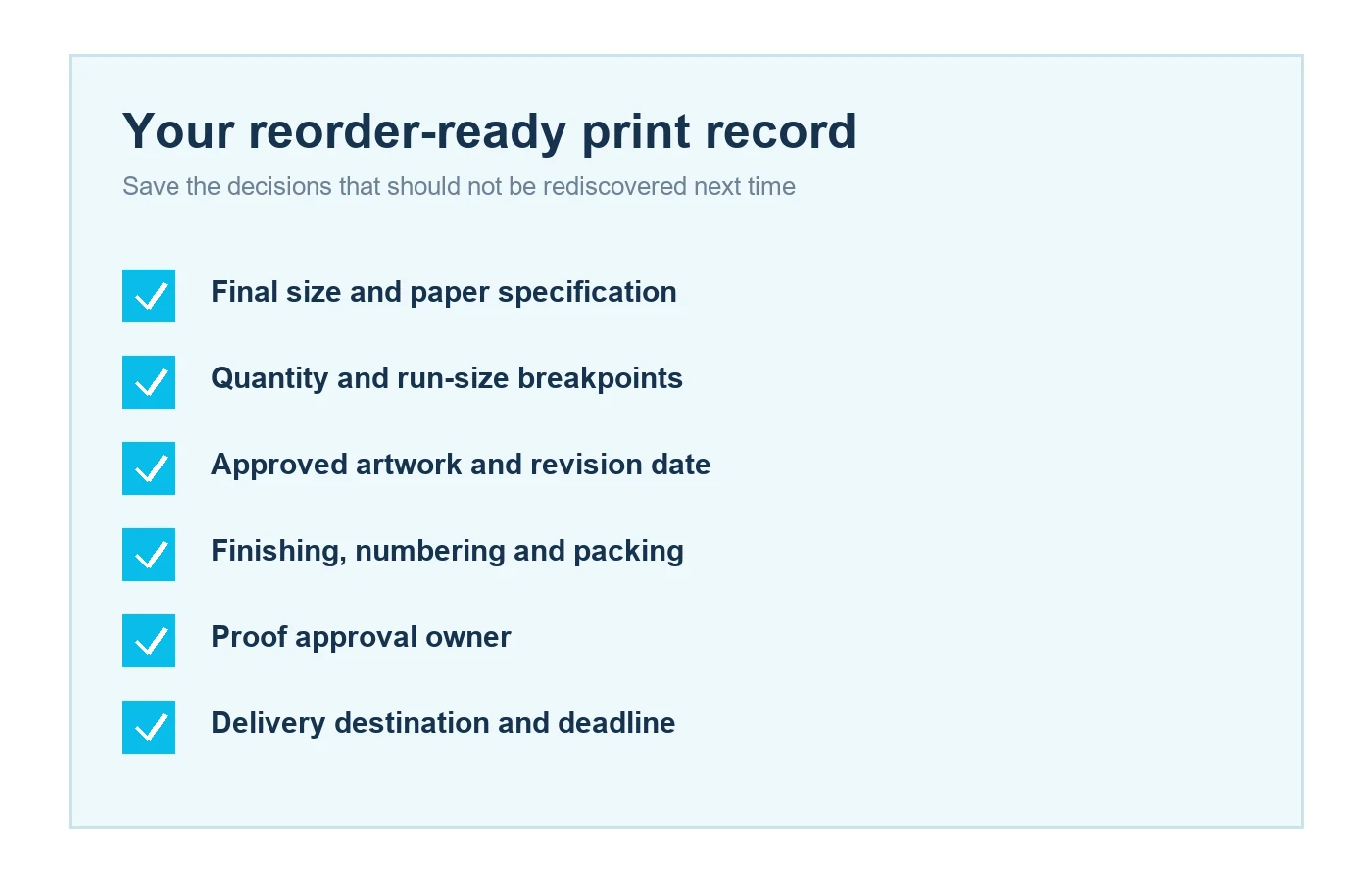
Shorter runs are easier to manage when the next order does not begin from memory. After approving a job, store a one-page reorder record beside the final artwork.
- product name and internal item code;
- approved artwork filename and version date;
- finished size and orientation;
- paper and printing-color description;
- copy parts, page count or sheet count;
- binding, perforation, numbering and other finishing;
- quantity per design or location;
- packing, proof approval and supplier reference;
- fields that may change at the next reorder.
The record should describe the physical product, not just link to a PDF. A file can be renamed or separated from its email history. A compact specification makes it easier to check whether a new quote matches the last approved order.
Questions to Ask Your Printer
Use these questions before approval, not after a deadline becomes urgent:
- Which specifications must be fixed before an accurate quote?
- Which alternatives preserve the intended function?
- What artwork format and version information should be supplied?
- How will the proof be delivered, and what counts as final approval?
- Which details can vary between designs without creating a different product?
- How should branches, departments or carton labels be listed?
- What should be retained to make the next reorder faster and more accurate?
The supplier may need more information for a particular product. The goal is not to make the brief long. It is to remove ambiguity around decisions that affect construction, artwork or packing.
Choose the Right Product Path
The latest industry information points toward shorter, faster and more carefully measured print buying. Small businesses can respond without sacrificing control: lock the functional specification, preserve flexibility in version and quantity, centralize proof approval, and save a reorder-ready record.
Choose the product category that matches the job, then prepare the size, quantity, paper, colors, finishing, artwork, packing and delivery destination. When those details are ready, request a custom printing quote so the order can be reviewed against one clear brief.
Sources
- PRINTING United Alliance, State of the Industry Report 2026 Executive Summary
- PRINTING United Alliance, Industry Benchmarking Reports
- Intergraf, Print Matters 2026 conference summary