 yuanming@yuanming.com.cn
  86-755-89703008
Overseas Printing Orders: How to Compare the True Landed Cost

The landed cost for printing orders is the estimated amount paid to move a finished order from the supplier to the named destination—not just the price of printing. For a useful comparison, every overseas quote must use the same product specification, delivery place and responsibility split, then account for freight, insurance, import duty, tax, brokerage, destination handling and final delivery where applicable.
This matters more when budgets are tight. PRINTING United Alliance’s 2026 industry research found that 61.3% of surveyed printing companies were seeing greater client price sensitivity. A low unit price can look attractive, but it does not answer the buyer’s real question: what will this order cost when it is available for use?
Why Product Price Is Not Landed Cost
The U.S. International Trade Administration defines landed cost as the total price after a product reaches the buyer. Its framework includes the original product price, insurance, freight, tariffs and taxes, plus other fees. The exact calculation depends on the destination, customs classification, shipment method and contract.
That is why two international printing quotes cannot be compared from the product total alone. One may include transport to the buyer’s address. Another may stop at a port, airport or terminal. A third may include freight but leave import clearance, duty and local delivery to the buyer.
Treat all duty and tax figures as estimates until the applicable customs authority or a qualified broker confirms them for the exact goods and entry date. Rates and fees can change, and visually similar paper products may not share the same classification.
Build the Cost Stack
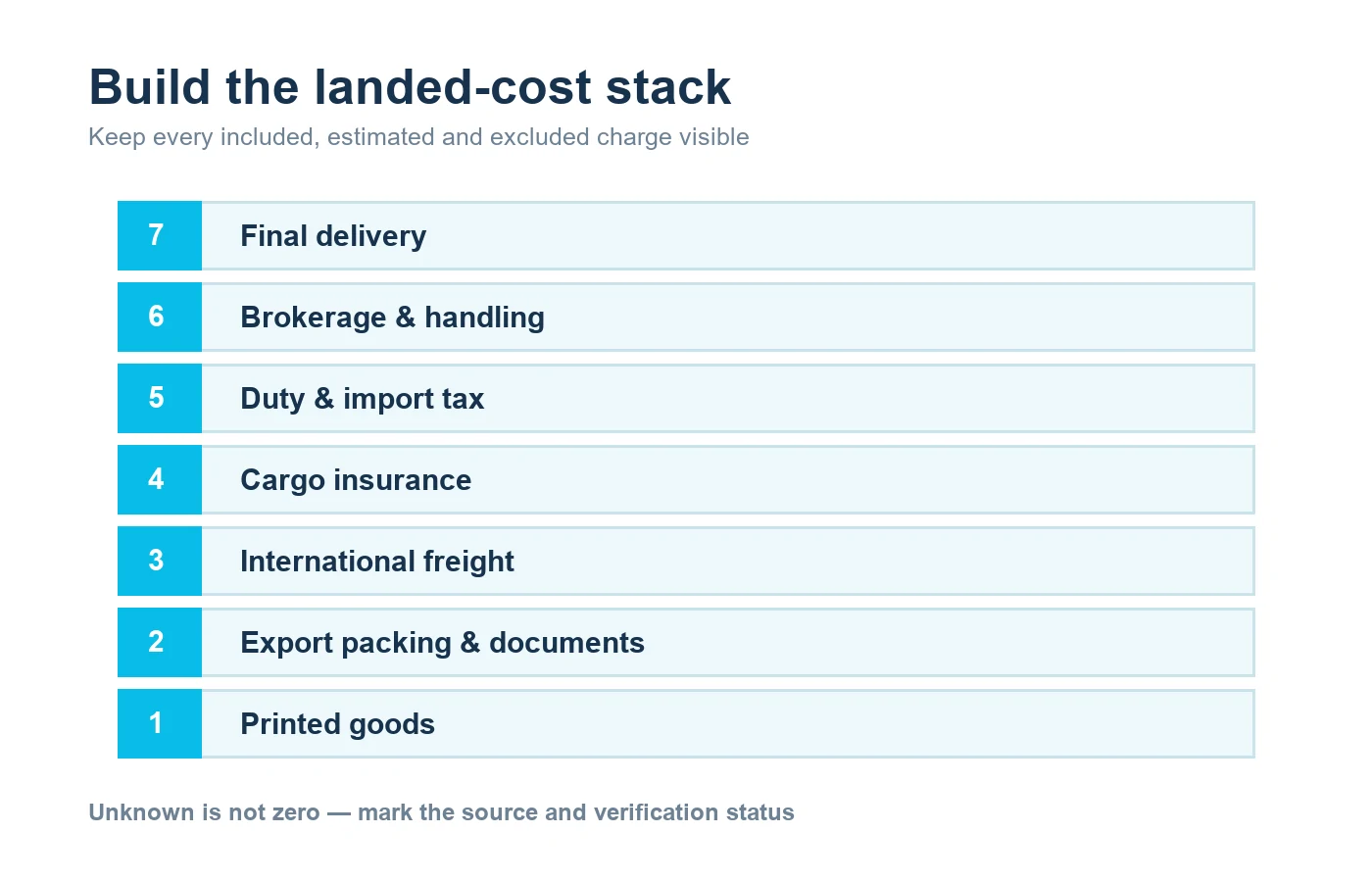
Build the comparison from separate cost layers. Do not hide unknown charges inside a single “shipping included” line.
| Cost layer | What to record | Who should confirm it |
|---|---|---|
| Printed goods | Quantity, versions, size, paper, colors and finishing | Printing supplier |
| Export preparation | Cartons, pallets, labels and export documents included in the quote | Supplier and forwarder |
| Main transport | Air, sea, courier or another mode; chargeable basis and named destination | Forwarder or carrier |
| Insurance | Whether cargo cover exists, its scope and declared value | Seller, buyer or insurer as agreed |
| Import charges | Estimated duty, VAT/import tax and customs fees | Customs authority or broker |
| Clearance and handling | Brokerage, terminal, storage, inspection or disbursement fees | Broker, carrier or terminal |
| Final delivery | Delivery from the arrival point to the actual business address | Carrier or local delivery provider |
If a line is unknown, label it “not included” or “estimate required.” That is more useful than entering zero, which can make an incomplete quote appear cheaper.
Fix the Product Specification
Freight and import comparisons are unreliable when the products are different. Paper weight, finished size, page or sheet count, copy parts, binding and packing can change the shipment weight, volume and commercial value.
Create one specification before requesting prices. For custom business forms, define the finished format, number of NCR parts, sets per book or pad, numbering and perforation. For custom notebook printing, record the format, page count, binding, cover and packing. A restaurant paper printing brief should identify the exact item, size, artwork versions, quantity and packing requirement.
Also ask for gross shipment weight, carton count and carton dimensions after the specification is confirmed. These figures let a forwarder compare transport on the same physical basis. Preliminary estimates are acceptable during sourcing, but the final logistics quote should follow the approved product and packing plan.
Name the Delivery Responsibility
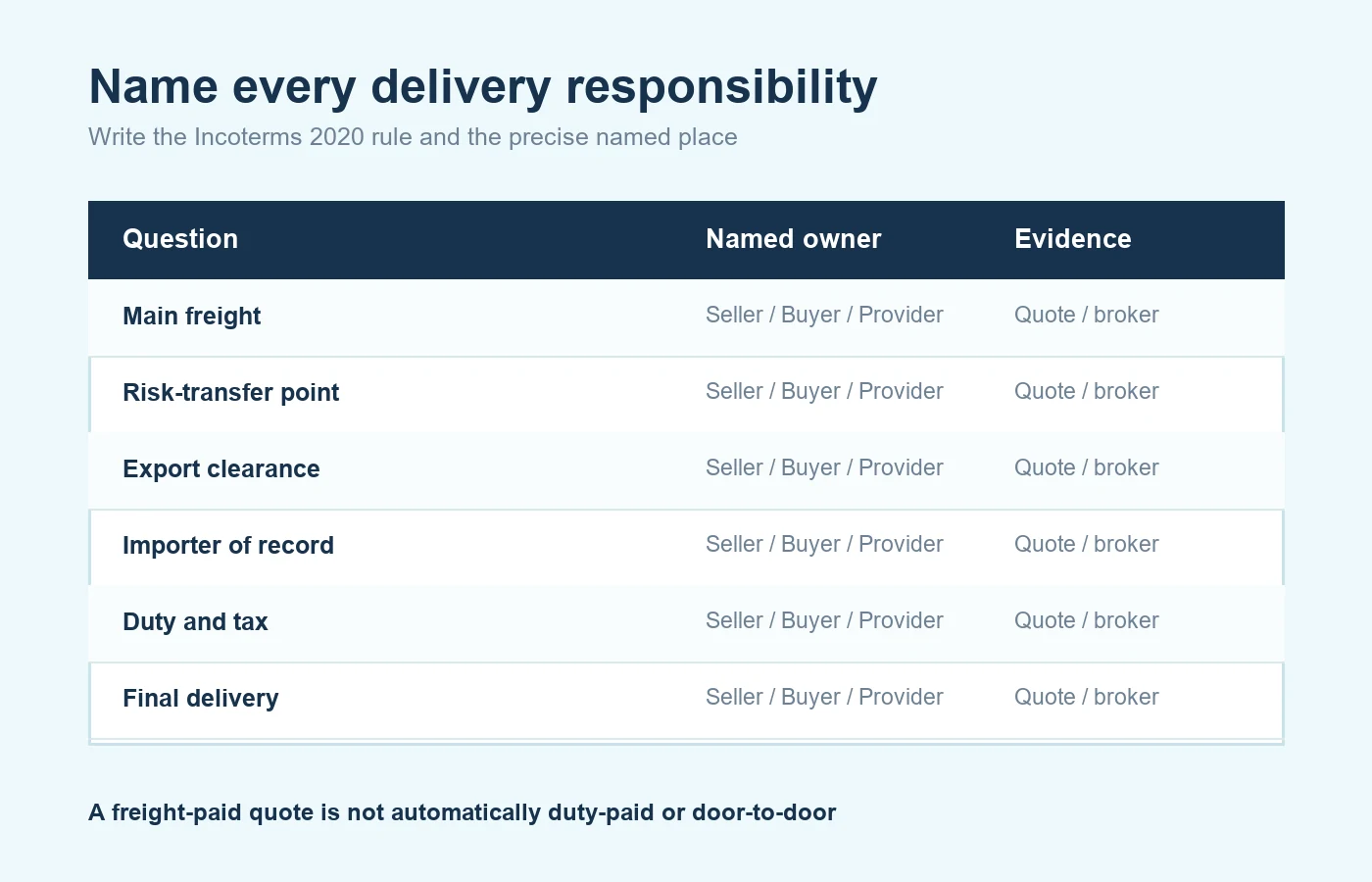
International Commercial Terms, commonly called Incoterms, allocate transport tasks, costs and risk between seller and buyer. They do not replace the product specification, payment terms, title transfer or complete sales contract.
Never accept an abbreviation by itself. Record the selected Incoterms 2020 rule and the precise named place—for example, the buyer’s address, a port or another agreed location. Then ask the following questions:
- Who arranges and pays for the main freight?
- Where does risk transfer from seller to buyer?
- Who completes export clearance?
- Who acts as importer of record and completes import clearance?
- Who pays duty, import tax and brokerage?
- Does the named place include unloading and delivery to the actual receiving door?
A delivered quote is not automatically duty-paid, and a freight-paid quote is not automatically door-to-door. The named rule and place make the handoff visible. Ask a customs broker or freight forwarder to review the arrangement when the buyer is unsure who can legally complete import formalities.
Check US Import Costs
For a US destination, begin with the likely Harmonized Tariff Schedule classification, country of origin, customs value, shipment method and importer of record. Do not let a supplier’s informal code suggestion replace the importer’s verification.
Current U.S. Customs and Border Protection guidance states that the importer remains responsible for meeting CBP requirements even when a licensed customs broker handles the entry. CBP also explains that formal and informal entries can carry processing fees and that ocean shipments can have additional harbor fees. The applicable amount depends on the entry and should be checked at the time of shipment.
Low-value assumptions also need a current check. CBP’s published guidance says duty-free de minimis treatment for many shipments ended on August 29, 2025. A small sample parcel and a commercial order therefore should not be budgeted from an outdated “under $800 is always duty-free” rule. Confirm current treatment with CBP, the carrier or a broker before shipping.
Check EU and UK Imports
For an EU destination, the European Commission’s Access2Markets import guidance points businesses to tariffs, rules of origin, taxes, additional duties, procedures, formalities and product requirements. Use the destination country and the exact customs classification rather than applying one generic “EU import rate.”
VAT treatment, customs representation and local delivery charges can affect cash flow even when a business may later recover eligible input tax. Ask the importing entity and its adviser how the transaction should be structured; the printing supplier should not be expected to determine the buyer’s tax position.
The United Kingdom has its own tariff, VAT and import procedures. A quote for Germany, France or another EU member should not be copied into a UK worksheet without rechecking the destination rules. The same principle applies within Europe whenever the delivery country or importing entity changes.
Compare Quotes on One Sheet
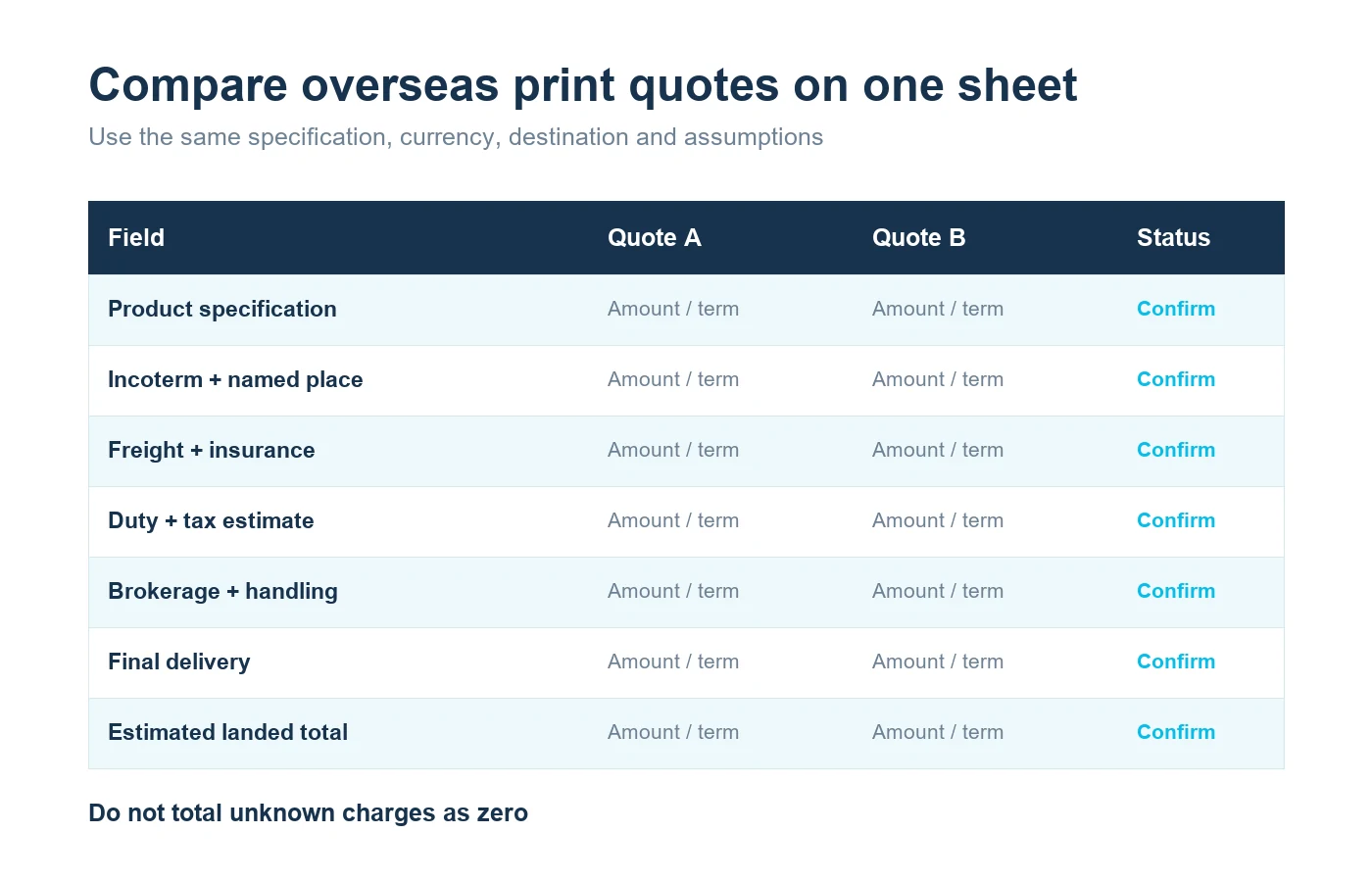
Place each supplier in a column and each cost layer in a row. Use the same currency and show the exchange-rate date. Separate confirmed figures from estimates and exclusions.
| Comparison field | Quote A | Quote B | Check |
|---|---|---|---|
| Identical product specification | Yes / No | Yes / No | Resolve differences first |
| Product and packing total | Amount | Amount | Same currency |
| Incoterm and named place | Term + place | Term + place | Responsibilities aligned |
| Main freight and insurance | Included / estimate | Included / estimate | Same mode and basis |
| Duty, tax and customs fees | Estimate / excluded | Estimate / excluded | Verified source noted |
| Brokerage and destination charges | Amount / unknown | Amount / unknown | No hidden zeroes |
| Final delivery | Included / excluded | Included / excluded | Actual receiving address |
| Estimated landed total | Total | Total | Same assumptions |
Then compare operational risk, not only the total. A slightly higher estimate may be easier to manage when its responsibilities, shipment basis and exclusions are clear. Conversely, a quote with several unknown destination charges is not yet a complete landed-cost comparison.
Prepare a Quote-Ready Enquiry
Give the printing supplier enough information to price the physical order and prepare useful logistics data:
- product type and intended use;
- finished size, paper, printing colors and finishing;
- parts, pages or sheets per finished item;
- quantity for each artwork version;
- packing or carton-label requirements;
- full destination city, postal code and country;
- requested delivery basis or a request for available alternatives;
- whether the buyer has a broker or forwarder;
- the date by which the goods are needed, stated as a planning requirement rather than a guaranteed lead time.
PrintingMaxx can review the print specification and prepare a product quotation from the information supplied. Customs classification, duty, tax and importer obligations should still be verified for the buyer’s destination and transaction. When the product and delivery details are ready, request a detailed printing quote and use the cost-stack worksheet to compare it on the same basis as other proposals.
Sources
- U.S. International Trade Administration, Determine Total Export Price and Shipping Options
- U.S. Customs and Border Protection, current guidance on customs brokers, duties and fees, and low-value mailed goods
- European Commission, Importing into the EU
- International Chamber of Commerce, ICC Guide to Incoterms 2020
- PRINTING United Alliance, State of the Industry Report 2026 Executive Summary