 yuanming@yuanming.com.cn
  86-755-89703008
Invoice Book vs Receipt Book: Which Does Your Business Need?
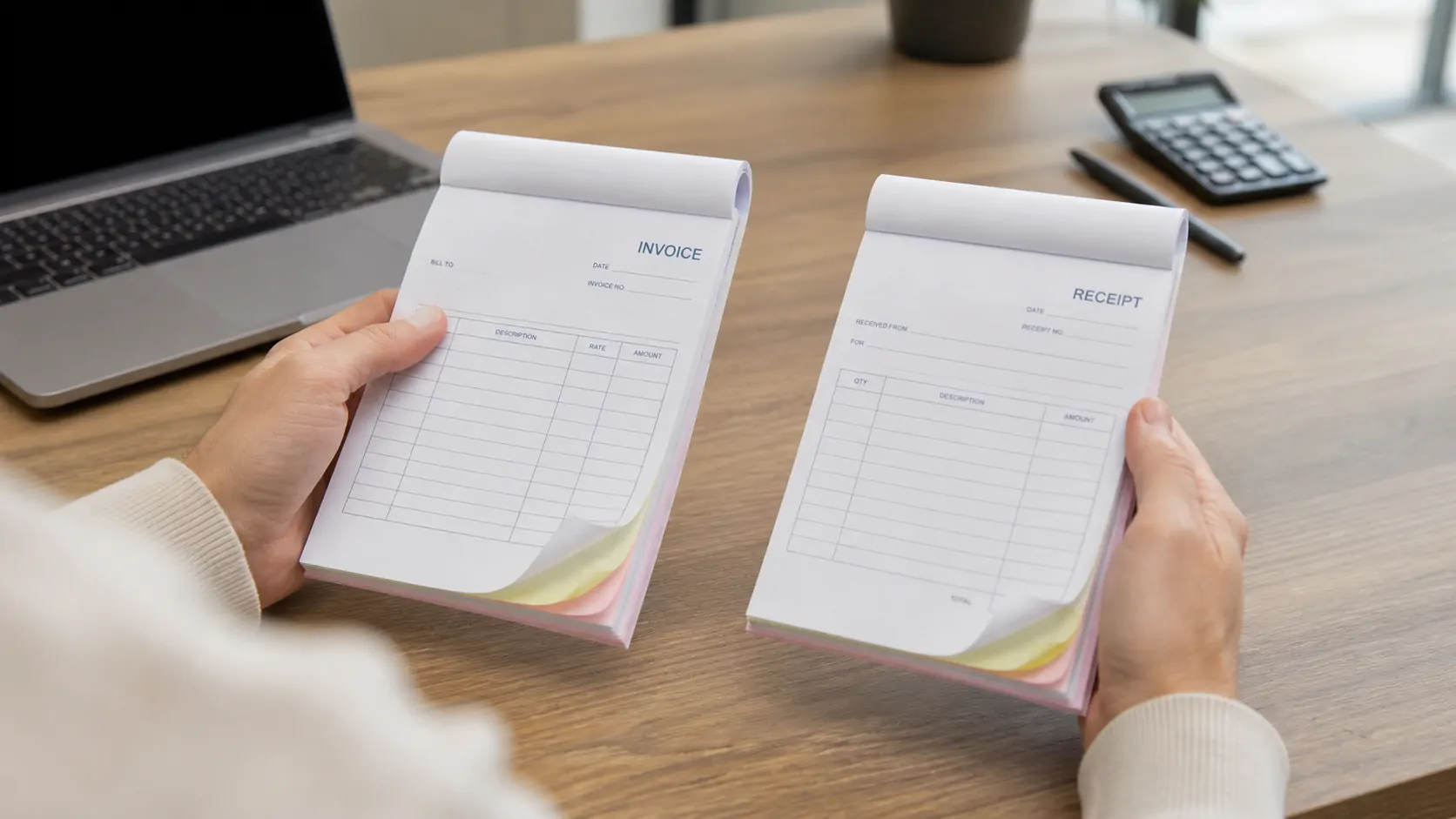
An invoice book vs receipt book decision becomes simple when you look at the moment each document is issued. An invoice asks a customer to pay. A receipt confirms that payment has been received. Many small businesses need both, but they should not use the two records interchangeably.
For a printed workflow, the product choice also affects copy routing, numbering, fields, book size and filing. This guide follows one transaction from completed work to paid account, then turns that process into a quote-ready print specification.
Quick answer: Choose an invoice book when you need to record an amount due and payment terms. Choose a receipt book when you need to acknowledge a completed payment. Choose both when payment is commonly collected after the invoice is issued.
Invoice Book vs Receipt Book
The difference is not just the heading printed at the top.
| Record | Main purpose | Usually issued | What happens next |
|---|---|---|---|
| Invoice | Requests payment and records what is owed | After goods or services are supplied, or at an agreed billing point | Customer pays or disputes the charge |
| Receipt | Confirms money was received | At or after payment | Customer and seller retain proof of the transaction |
The UK government’s invoicing guidance makes the distinction directly: an invoice is a request for payment and is different from a receipt, which acknowledges payment. The exact information required on either document varies by country, tax status and transaction type, so treat this workflow guidance as a starting point—not legal or tax advice.
Follow One Transaction
Imagine a maintenance company completing a repair at a customer site.
- The technician records the work and materials used.
- The office prepares an invoice showing the customer, services, amount due and payment terms.
- The customer pays by cash, card, bank transfer or another agreed method.
- The business issues a receipt confirming the amount and date paid.
- Copies are filed with the job record and accounting records.
If the customer pays immediately at the counter, a receipt may be the only customer-facing payment record needed for a simple sale. If the customer pays later, the invoice and receipt serve two separate moments. Mapping those moments prevents staff from writing “paid” on an invoice when a dedicated receipt would create a clearer audit trail.
What an Invoice Book Records
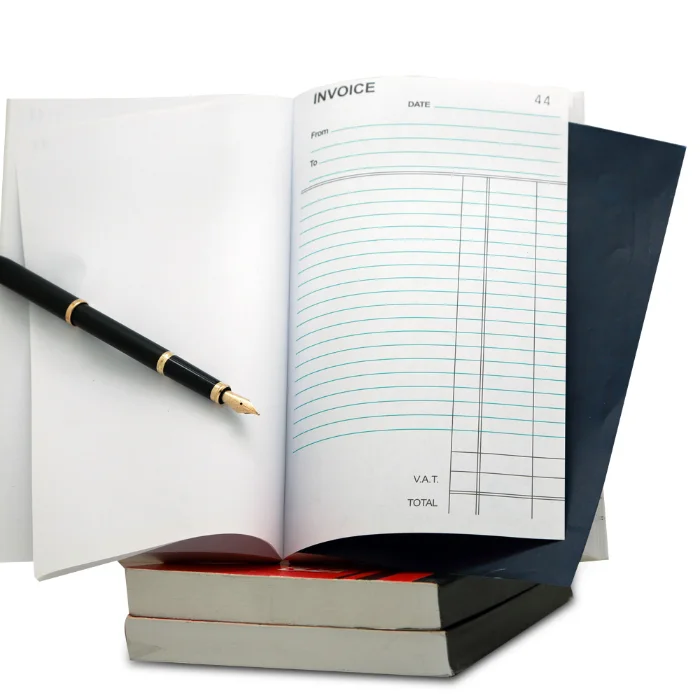
An invoice book is designed around the amount due. Its layout commonly needs space for:
- a unique invoice number;
- issue date and, where relevant, supply date;
- seller and customer details;
- descriptions, quantities and prices;
- subtotal, discounts, taxes and total due;
- payment terms, due date and payment instructions;
- purchase order, job or account references.
For UK businesses, official guidance lists specific invoice information and additional VAT invoice rules. EU VAT invoicing requirements also depend on the transaction and jurisdiction. In the United States, recordkeeping expectations are spread across tax, state and industry rules rather than one universal invoice format. Before printing a large run, have your accountant or local tax authority confirm the fields your business must retain.
A custom book is useful when invoices are written away from a computer, when a sequential paper record is required, or when one copy must stay bound in the book. See custom invoice book printing for available construction and finishing options.
What a Receipt Book Records
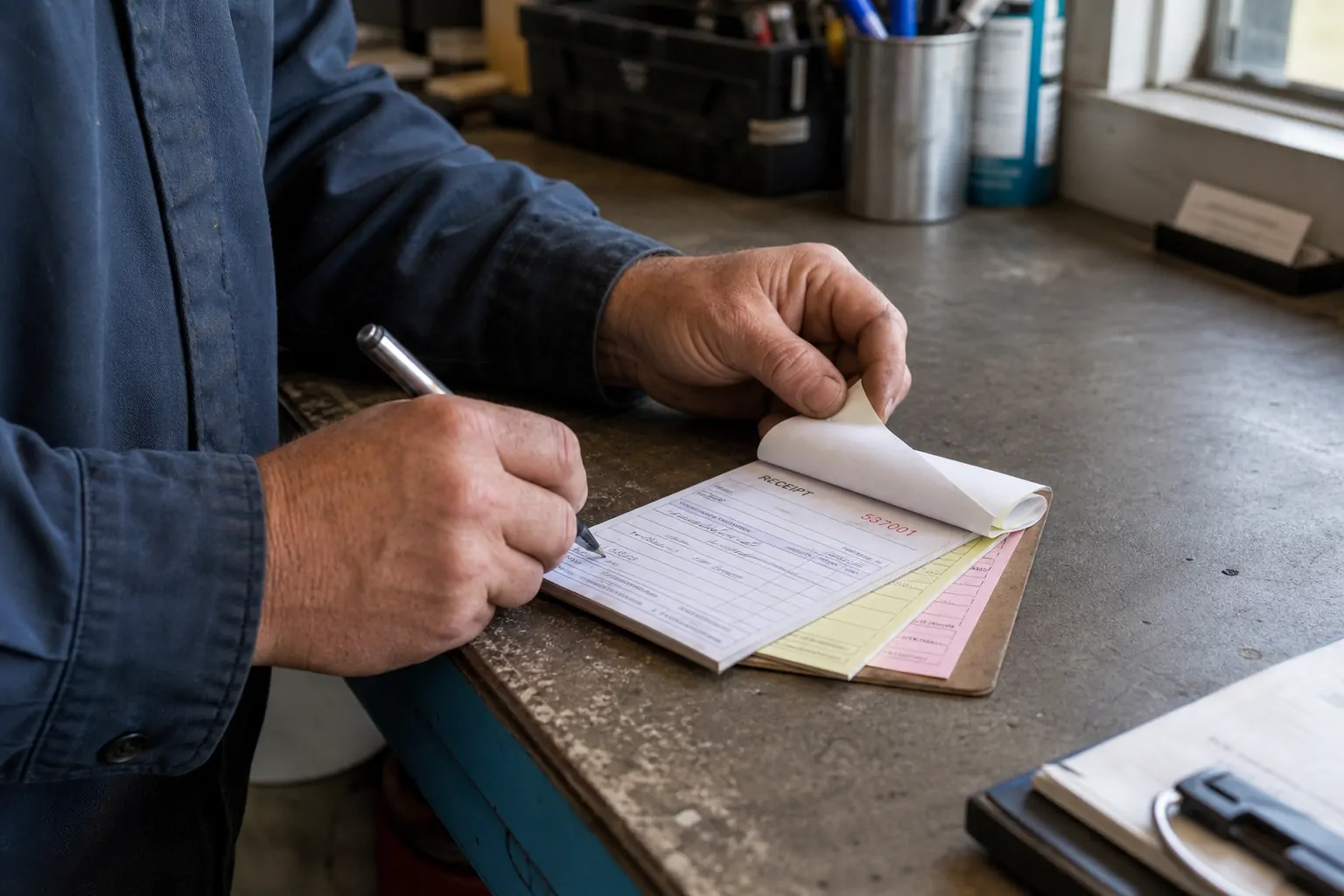
A receipt book is built around payment received. It usually needs:
- a unique receipt number;
- payment date;
- payer or customer name when relevant;
- amount received;
- payment method or reference;
- what the payment covers;
- balance remaining, if any;
- staff name or signature.
The IRS describes invoices and receipt books as supporting documents that can substantiate entries in business records. The Canada Revenue Agency likewise requires business records to support income and expenses. Those principles make legibility, orderly numbering and consistent filing valuable even where a particular printed template is not prescribed.
For cash collection, deposits, rent, field payments or counter service, a multipart receipt book can give one copy to the customer while retaining another. Review custom receipt book printing when you know who receives each copy.
When You Need Both
You probably need both documents when there is a delay between requesting and receiving payment. Common examples include trade accounts, service work billed after completion, deposits followed by final balances, and business-to-business orders with agreed payment terms.
- Payment requested now, collected later: issue an invoice, then a receipt after payment.
- Payment collected immediately: issue a receipt; decide whether another sales document is required by your accounting or tax process.
- Partial payment collected: keep the invoice balance clear and issue a receipt for the amount actually received.
- Electronic system sends confirmations: decide whether the printed book is a backup, field record or primary record before ordering it.
Do not add a second book merely because it looks more professional. Add it when it closes a real information gap between the amount due and the amount paid.
Choose Copies and Numbering
Once the document type is clear, specify where every sheet goes.
| Workflow | Typical starting point |
|---|---|
| Customer plus office file | 2-part set: original and one copy |
| Customer, field employee and office | 3-part set: original and two copies |
| Bound sequential office record | Book format with one copy retained in the book |
| Forms distributed individually | Pads or loose sets may be easier than bound books |
These are starting points, not fixed rules. A “2-part” set means two sheets total, while a “3-part” set means three sheets total. Name the recipient of each part before selecting copy colors.
Sequential numbering helps staff match the customer copy, retained copy and accounting entry. Decide whether the number should appear on every part, where the sequence starts and whether separate branches need separate ranges. Also confirm perforation position, writing shield requirements, binding side and the number of sets per book.
Check Regional Requirements
North American and European buyers should avoid assuming that one generic template is compliant everywhere.
- In the UK, invoice requirements vary for sole traders, limited companies and VAT invoices.
- Across the EU, VAT invoicing rules depend on the seller, customer, transaction and member-state requirements.
- In the US and Canada, tax and recordkeeping rules may require supporting documents, but the precise form can depend on jurisdiction and business activity.
Use official government guidance for the market where the transaction occurs. Keep records readable and organized, but do not print tax labels, registration numbers or mandatory declarations until a qualified adviser has approved the wording.
Build the Print Specification
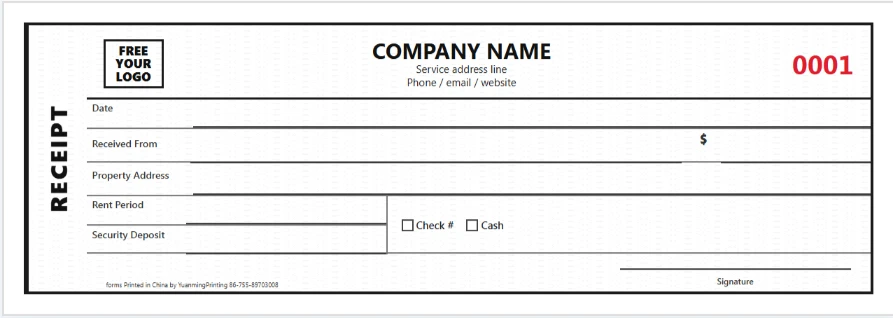
Before requesting a quote, write one compact specification:
- document: invoice book, receipt book or both;
- finished size and orientation: for example A5 portrait or a US-friendly custom size;
- parts per set: 2-part, 3-part or another confirmed construction;
- copy routing: who keeps each sheet;
- sets per book and quantity: include total books and total sets;
- numbering: start number, digit count, position and whether every part is numbered;
- finishing: binding edge, perforation, wraparound cover and writing shield;
- artwork: logo, fields, terms, tax details and approved language;
- packing and destination: especially for export orders.
Send a sample completed form—not real customer data—if the workflow is difficult to describe. It helps the printer see where handwriting space, totals, signatures and copy colors matter.
Send a Quote-Ready Enquiry
The invoice book vs receipt book choice begins with a clear business event: an invoice asks for payment; a receipt confirms it. Map who creates the record, who receives each copy and how it is filed. Then confirm the legal and tax fields for your market before approving artwork.
If you are comparing custom invoice and receipt books for a small business, contact PrintingMaxx with your size, parts per set, quantity, numbering and destination. We can review the production specification and prepare a quote while you retain responsibility for approving the business and regulatory wording.
Frequently Asked Questions
Can a paid invoice replace a receipt?
Some businesses mark an invoice as paid, but that does not automatically make it the best receipt for every market or workflow. Confirm local requirements and whether customers need a separate payment acknowledgement.
Should invoice and receipt numbers use the same sequence?
Usually they are separate document series because they record different events. Your accounting process may link them through an invoice number, job number or customer reference.
Do I need duplicate or triplicate books?
Choose the part count from copy recipients. Two recipients usually need a 2-part set; three immediate paper recipients usually need a 3-part set.
Can one book contain both invoices and receipts?
It can, but mixed books may confuse numbering, filing and staff training. Separate books are normally clearer when payment happens after invoicing.
What should I verify before printing?
Approve the required fields, regulatory wording, numbering sequence, copy colors, part count, size, perforation, binding, quantity and destination. Test a proof with the people who will complete and file the forms.
Sources