 yuanming@yuanming.com.cn
  86-755-89703008
Restaurant Guest Check Problems: Fix the Habits Behind Order Errors
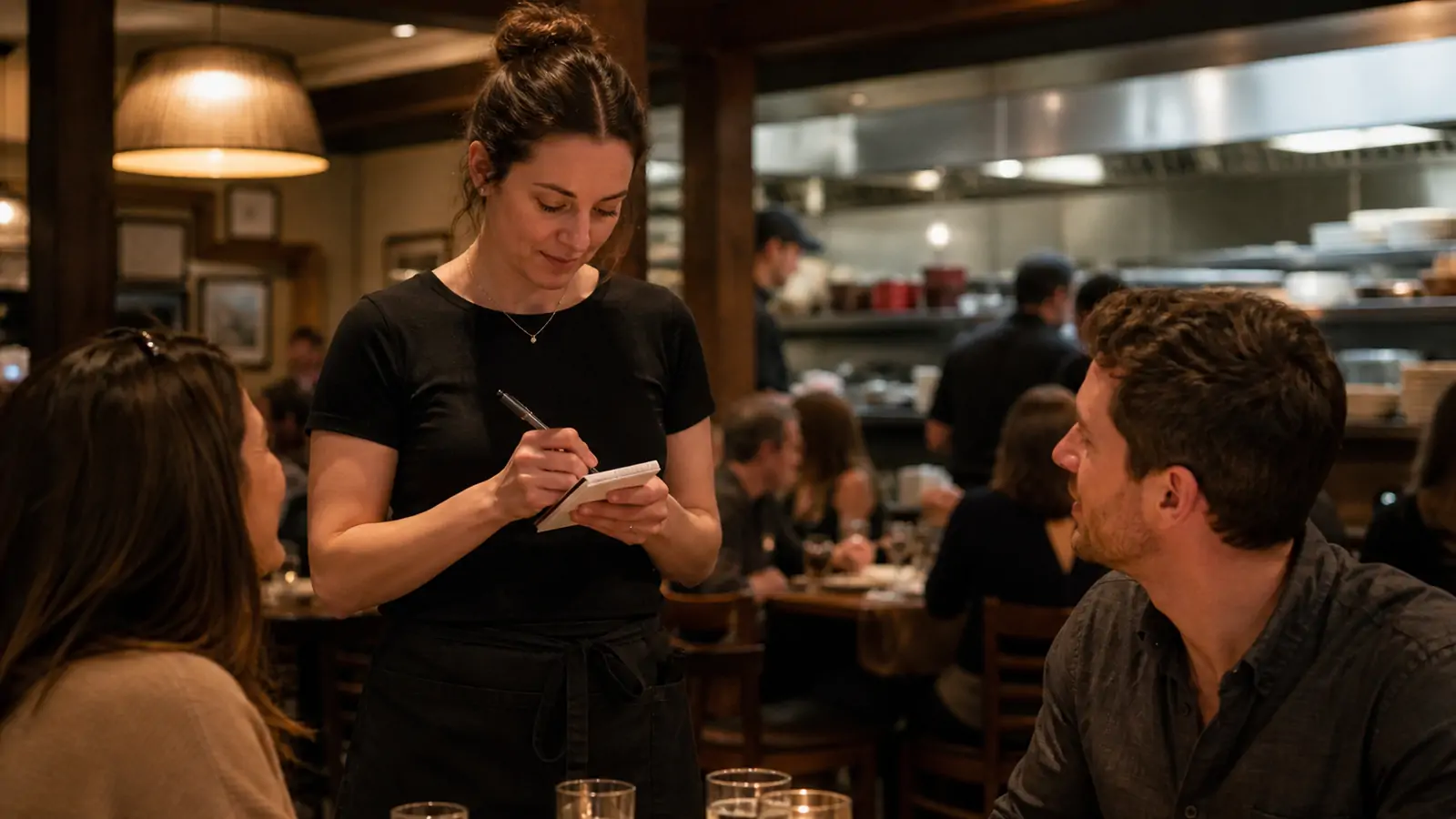
Restaurant guest check problems often begin with a reasonable shortcut: a server waits a few seconds before writing, invents personal shorthand, rewrites an order near the POS, or assumes the next person will recognize the table. The paper is blamed when information becomes unclear, but the form and the routine usually need to be examined together.
The useful question is not “Do we need more boxes?” Follow one order through a real shift and ask where somebody must remember, interpret, copy, search or guess. Those points show whether the restaurant needs a clearer habit, a better guest-check prompt, or both.
The practical rule
Standardize when staff write, how they mark recurring modifiers, which identifier follows the order, and who owns the final check. Then redesign only the parts of the form that support those agreed actions.
Restaurant Guest Check Problems
A guest check crosses several boundaries. A customer describes the order, a server records it, the kitchen interprets it, a runner matches food to a table, and somebody closes or files the record. Information can change at every boundary even when each person is working carefully.
Technology does not remove the need for a clear route. Oracle’s restaurant documentation distinguishes guest checks, order devices and journals, while Toast allows restaurants to control how modifiers appear on printed and KDS kitchen tickets. Paper and digital systems both depend on stable identifiers and readable order detail. A paper guest check should therefore be designed around the same handoffs the team actually uses.
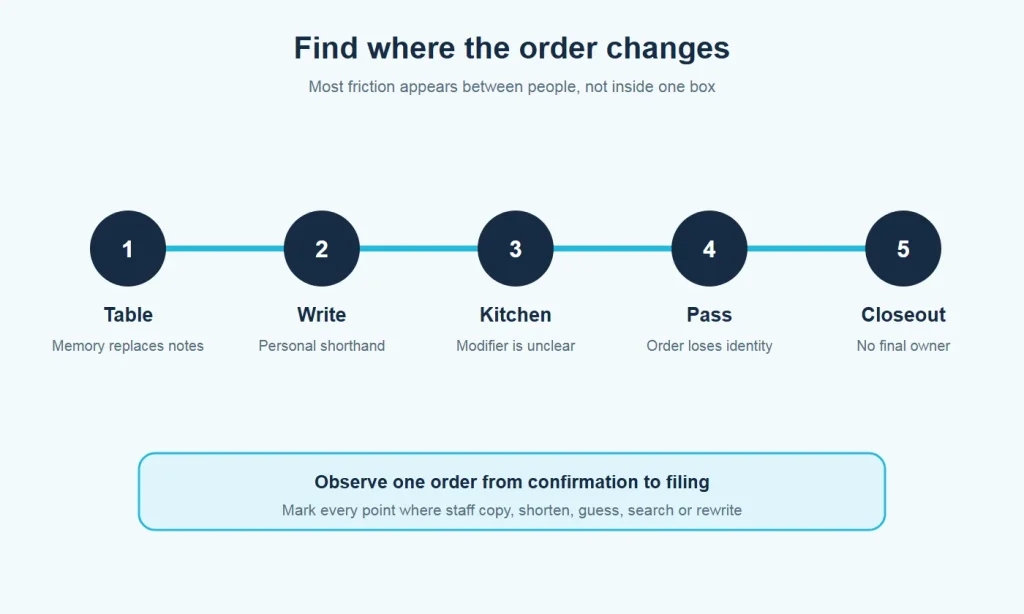
At the Table
The first weak habit is delaying the written record. A server may remember a simple drink order, then receive a question, a modifier or a request from another table before writing it down. The final note can be accurate, but the routine creates an avoidable memory step.
A study in the International Journal of Hospitality Management compared memorizing orders with writing them down across three experiments. It found no overall advantage to memorization, and muddled orders reduced participants’ ratings of service quality and expected tips. This does not prove that every memorized order fails. It does support a safer operating habit: record the order while the guest can still confirm it.
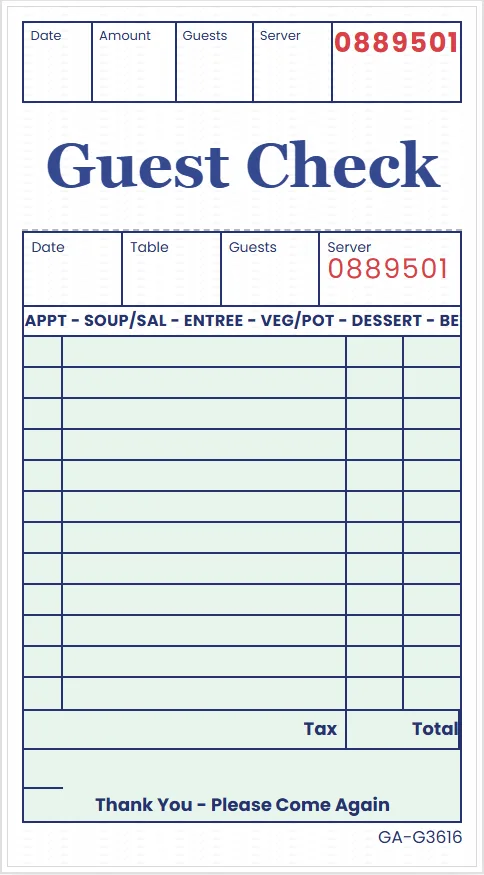
The form can reinforce the habit with a clear starting area: table or order identity, guest count when used, and enough open space for items and modifiers. It cannot force somebody to write immediately, so training and layout should be reviewed as one pair.
Before the Kitchen
Personal shorthand works only while the same person is reading it. Trouble starts when one server writes “NS,” another uses it for “no salt,” and a third means “no sauce.” Crowded lines make the difference harder to see, especially when a modifier is squeezed between items or added later.
Use a short, agreed notation set for frequent instructions and leave open writing space for exceptions. The set should reflect the restaurant’s menu rather than a generic abbreviation list. If a modifier changes how an item is prepared, place it directly with that item instead of in a detached notes area that the kitchen may overlook.
Toast’s current configuration guidance shows that even digital kitchen tickets need deliberate modifier order and display choices. The same principle applies to handwriting: the team should know where to look and in what sequence information will appear.
At the Pass
At the pass, the common pain point is lost identity. A cook can complete the right dish while the runner cannot connect it with the correct table, seat, order number or pickup name. Repeating several identifiers is not always better; competing numbers can create another interpretation step.
Choose one primary identity for the route and make it visually dominant. In table service, that may be table and seat. In counter service, it may be an order number. Oracle’s runner-chit documentation uses a guest-check ID or check number and can include table and seat information, illustrating why the identifier must survive the kitchen-to-runner handoff.
- Circle or box the primary identifier rather than writing it in an unused corner.
- Keep additions attached to the original identity.
- Define where completed checks wait and what mark shows they are ready.
- Avoid relying on verbal corrections that never reach the paper or POS record.
At Payment
Payment creates a second version of the order in many restaurants. Staff may total a paper check, enter it in the POS, split it by seat, apply a discount or correct a late item. If nobody defines which record controls a change, the paper and the system can disagree.
Decide when the POS entry occurs and how corrections are marked. If paper is the primary working record, write a clear status when it has been entered or settled. If the POS is primary and paper is a production aid, do not add accounting fields that staff will never complete. The aim is not to duplicate every screen; it is to preserve the information needed at the next handoff.
At Shift Closeout
A numbered check is only useful when the restaurant has a routine for it. Issuing pads without deciding who receives them, where completed checks go and how voided or unused checks are handled leaves the number without an operational meaning. Procedures vary, so the restaurant should define its own ownership and review rules rather than copy a generic control policy.
Observe the final ten minutes of a shift. Are checks gathered, left in apron pockets, mixed with payment receipts or discarded at different stations? The answer determines whether numbering, a status box, a retained copy or a different binding format would support the routine. Do not present any one feature as automatic fraud prevention or legal compliance.
Redesign the Routine
The best redesign starts with an observed behavior, not a wish list. For each problem, write the routine change first and the form response second. If the staff habit remains undefined, a new box will usually become another blank box.
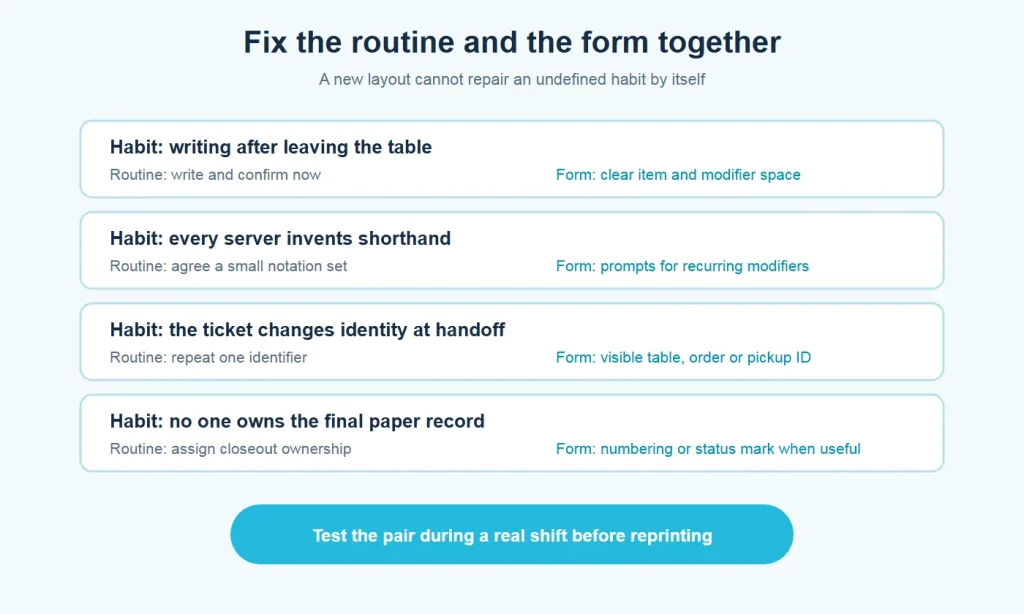
| Observed symptom | Habit to test | Possible form response |
|---|---|---|
| Modifier is interpreted differently | Use an agreed notation set | Add space or prompts for recurring modifiers |
| Runner searches for the order | Repeat one primary identity | Make table, seat or order number prominent |
| Staff rewrite details near the POS | Define entry timing and source of truth | Add a simple entered or completed status when useful |
| Checks have no owner after service | Assign a closeout location and person | Use numbering, retained copies or binding only when the routine requires them |
Test Before Reprinting
Test a revised routine with a temporary printout before ordering production quantities. Use real menu items and one realistic rush scenario. Include a modification, an added item, a split or transfer when those situations occur in the restaurant. The purpose is to discover where staff hesitate or invent workarounds.
The clearest way to diagnose restaurant guest check problems is to watch the same form in more than one person’s hands. A layout that feels obvious to its designer may still ask a server, cook or runner to search in a different place.
- Observe without coaching and mark every rewrite, question or search.
- Ask the kitchen and runner which information they noticed first.
- Remove fields nobody used and enlarge information people struggled to find.
- Repeat the test on another shift or with another staff member.
- Approve artwork only after the routine and layout work together.
Do not promise a fixed reduction in errors from this trial. Its value is practical: the purchasing decision is based on observed use rather than an attractive proof viewed only at a desk.
Prepare the Print Brief
Once the test is complete, turn the decisions into a production brief. Include the finished size, field layout, single- or multipart construction, copy color sequence, numbering requirements, perforation, binding edge, sets or sheets per book, quantity and delivery country. Attach a marked-up sample and explain the route each copy follows.
PrintingMaxx offers custom guest check printing and other restaurant paper printing products. When the routine is clear, send the tested layout and specifications through the PrintingMaxx contact page for review and quotation.
Sources: Oracle Simphony guest-check documentation, Oracle runner-chit guidance, Toast modifier-display documentation, and the hospitality study on memorized versus written orders.