 yuanming@yuanming.com.cn
  86-755-89703008
Notebook Binding Types: Choose for Daily Business Use

Notebook binding types should be chosen by what people do with the notebook, not by appearance alone. Start with four questions: must it open widely, fold back, travel in a bag, and keep pages secure through repeated use? Then test a physical sample and ask the printer to confirm the available construction, materials and page count.
This approach is especially useful for small-business buyers. A notebook that looks polished in a quotation can still feel awkward at a reception desk, in a service vehicle or during a standing site visit. The binding affects the writing area, the shape in a bag, the way pages turn and the impression the product gives over time.
Key takeaways
- Describe the required behavior before naming a binding.
- Compare opening, carrying, page retention and writing near the center.
- Test the actual notebook with the real user, pen and work surface.
- Treat production options, minimums, prices and lead times as quote-stage confirmations.
Compare Notebook Binding Types
The names below describe broad construction families. A supplier may use more specific terms, materials or combinations, so use this table to frame questions rather than to write a final specification.
| Binding family | What to test | Often considered when | Confirm before ordering |
|---|---|---|---|
| Wire-O, spiral or coil | Wide opening, fold-back use, punched-edge comfort and snagging | People write at a desk, counter or while holding the notebook | Wire or coil type, hole pattern, cover, page count and packing |
| Adhesive or perfect bound | Opening resistance, center writing space and spine response | A clean, book-like spine and compact profile matter | Adhesive system, page count, paper grain, cover and opening behavior |
| Sewn or case-style construction | Repeated opening, page retention, cover protection and weight | The notebook is intended for longer use or a more substantial presentation | Sewing and case construction, endpapers, cover board, weight and cost |
| Saddle-stitched booklet | Center spread, page count, cover flex and long-term handling | The item is slim, lightweight and used for a focused program or event | Page-count limit, paper, fold, staple position and intended lifespan |
The World Bank’s technical procurement guidance explains that binding changes durability, cost and production timing. It also distinguishes adhesive, sewn, wire/spiral and case constructions. Those observations are useful background, but a notebook used by an office team is not the same as a school textbook. Your sample test must reflect your own work.
Start With the Workday
Follow one employee for a normal day. Where is the notebook when the first note is written? Does it stay open beside a keyboard, balance on a counter, travel to a client meeting or sit in a vehicle? Does the user write on both sides of a spread? Must the front cover fold behind the back cover?
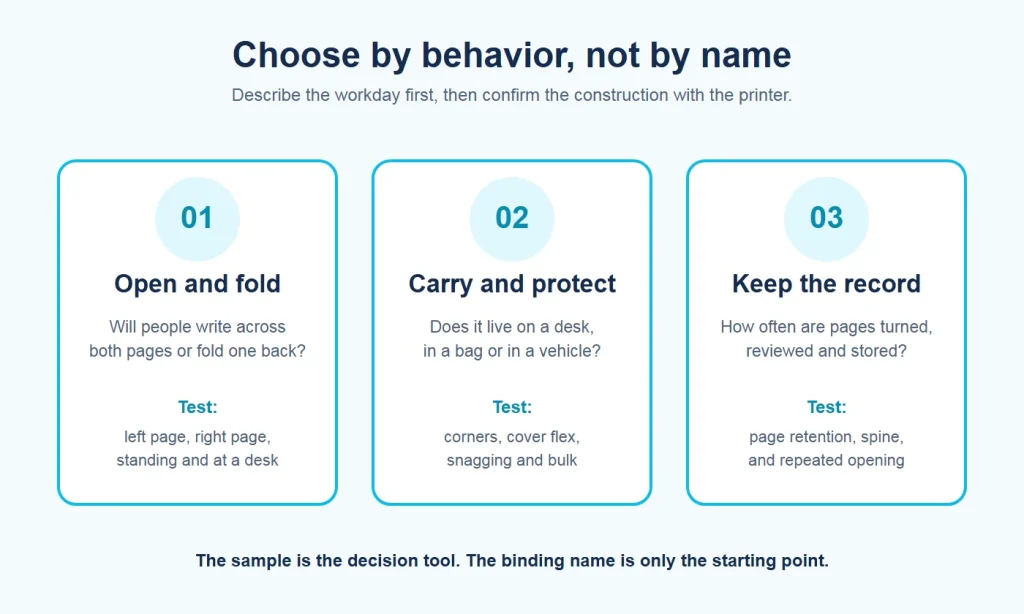
Record behavior in plain language. “Must fold back for one-handed notes” is more useful than “spiral preferred.” “Must look tidy on an executive meeting table” is clearer than “premium binding.” The printer can then explain which available construction is most likely to produce that behavior.
Test How It Opens
Opening behavior directly affects writing. Put each sample on the actual work surface and write a full line near the center from both the left and right pages. Notice whether a hand meets a wire, a raised page curve or a stiff center. Then try the same task while standing if employees regularly work away from a desk.
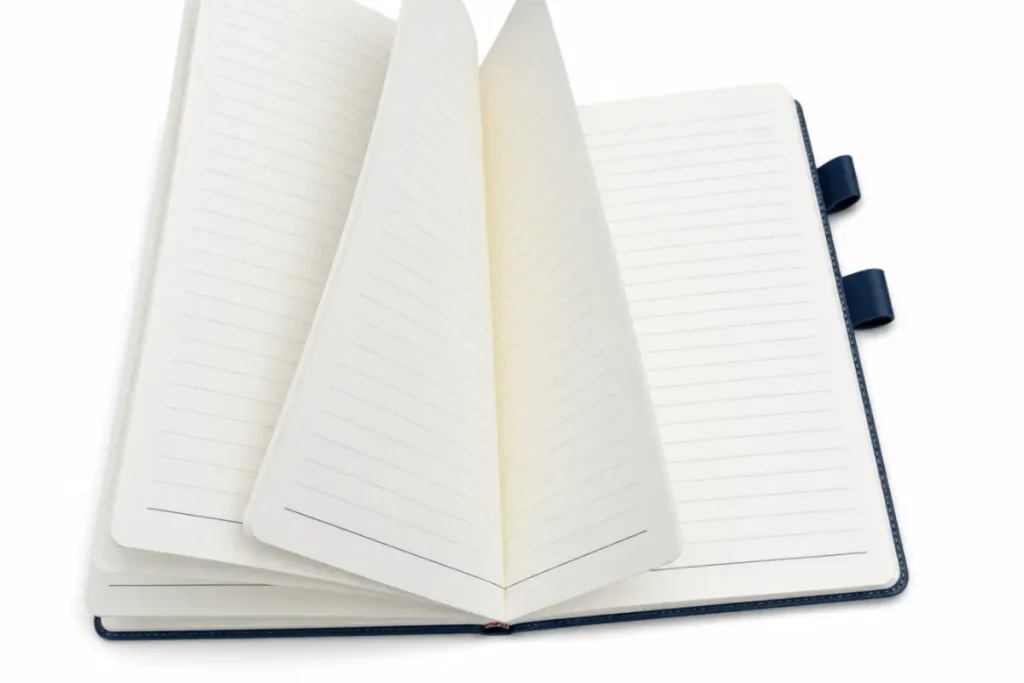
A wire or coil construction is commonly evaluated when wide opening or fold-back use matters. An adhesive-bound spine usually needs a different center-margin test because the pages and cover may resist opening fully. A sewn construction can support repeated opening, but the exact result depends on the complete book block and cover—not on the word “sewn” alone.
If page layout is still undecided, treat that as a separate decision. Binding determines physical behavior; ruled, grid, dot-grid, blank or custom interiors determine how the page guides the work.
Check Carrying and Protection
A notebook that stays on one desk faces a different life from one carried between job sites. Place the sample in the bag, kit or drawer employees actually use. Check whether a wire edge catches, whether the cover bends against other objects and whether the notebook adds uncomfortable bulk.
Cover and binding should be reviewed together. A rigid cover may protect pages but add weight. A flexible cover may pack easily but expose corners. Case-bound products can feel substantial, yet their extra mass may affect shipping and daily carrying. The World Bank guidance similarly notes that case binding can increase durability while also increasing weight and cost.
Check Page Retention
Ask how long notes must remain useful and how often older pages will be revisited. A training notebook used for one event has a different retention requirement from a maintenance log reviewed every week.
Turn through the sample repeatedly, including pages near the front and back. Look at the punched edge, adhesive spine or sewn sections. Do not try to predict years of use from a ten-minute test; instead, use the test to expose obvious mismatch and then ask for production samples or construction details appropriate to the expected life.
Also decide whether pages should ever be removed. If tear-out handoff is a core part of the workflow, a notebook may not be the only product needed. A separate notepad can handle removable notes while the notebook protects the continuing record.
Run a Sample Test
Use the same short routine on every candidate. Involve at least one person who will actually use the notebook; procurement preference is not a substitute for user behavior.
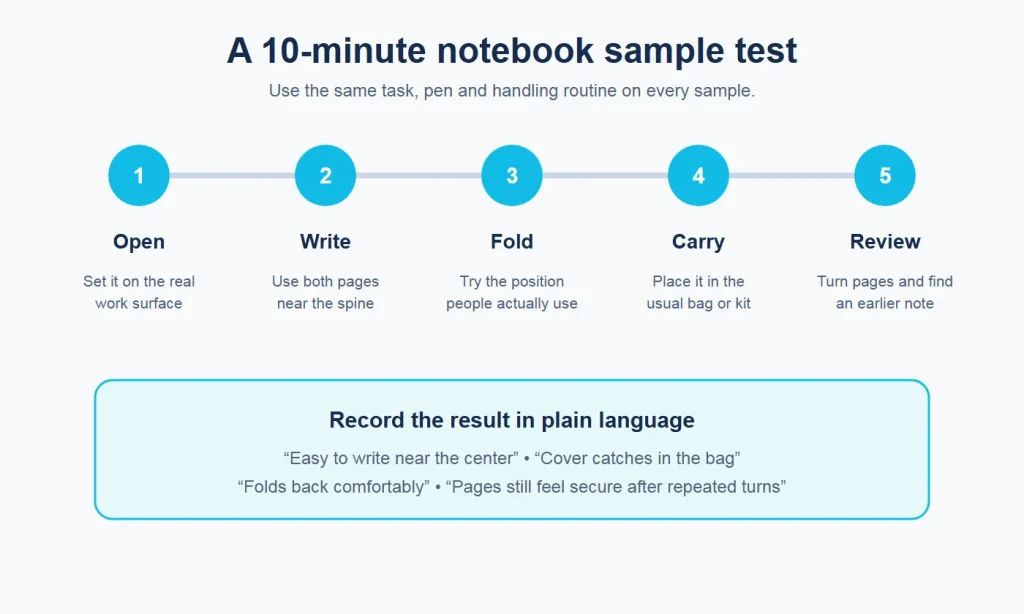
- Open: place the notebook on the real desk, counter or handheld support.
- Write: use the normal pen and write near the outer edge and center on both pages.
- Fold or hold: try the position used during a call, meeting or site visit.
- Carry: place it in the normal bag or kit and remove it several times.
- Review: turn back to an earlier note and check how easily the page can be found and read.
Score only criteria that matter. For example: writing comfort, opening stability, cover protection, carrying, page turning and perceived fit with the intended recipient. Add a short comment beside every score; numbers alone do not tell a printer what to change.
Prepare the Quote
Once you understand the behavior, prepare a brief that can be quoted accurately. Include:
- intended user and work setting;
- finished size and orientation;
- quantity and delivery destination;
- page count and interior printing;
- preferred binding family, if known;
- required opening or fold-back behavior;
- cover protection and carrying conditions;
- page-retention expectations;
- artwork status and brand-color references;
- packing needs and requested schedule for confirmation.
PrintingMaxx has a verified page for custom notebook and notepad printing. Use it to identify the product family, then ask the team to confirm current binding, paper, cover, minimum-order and finishing options. If you have a physical reference, photograph the front, spine, open center and page edge rather than sending only a product name.
When the brief and artwork are ready, contact PrintingMaxx for a quote and sample discussion. The goal is not to find a universally best binding. It is to specify a notebook that behaves naturally in the reader’s workday.
Notebook Binding FAQs
Which notebook binding lies flat?
Wire-O, spiral and coil constructions are commonly considered when wide opening or fold-back use is important. Some sewn constructions may also open well. Do not rely on the category name: test the actual sample and confirm the finished construction.
Is hardcover always more durable?
A rigid case can protect the book block, but durability depends on the cover materials, binding, paper, manufacturing and handling together. It can also add weight and cost. Match the sample to the expected use.
Should price decide the binding?
Price matters, but compare the total requirement. A lower-priced notebook that employees avoid or replace early may not be the lower-cost choice. Request comparable specifications and confirm current pricing with the supplier.
What should I send for an accurate quote?
Send size, quantity, page count, interior artwork, cover concept, expected opening behavior, use environment, destination and requested timing. Add photographs or a physical sample when a particular feel or construction must be matched.
Technical reference: World Bank binding specifications guidance, especially the binding overview on pages 16–19.