 yuanming@yuanming.com.cn
  86-755-89703008
Custom Printing Cost Trends: What Buyers Should Watch Before Reordering

Current custom printing cost trends do not point in one direction. In the United States, the Bureau of Labor Statistics reported that paper producer prices were 0.3% lower in August 2026 than a year earlier, while paperboard was 2.3% higher. Private-industry compensation was still rising, and global container freight remained expensive and route-sensitive. Import charges then depend on classification, origin, value, destination and the agreed trade term.
For a small-business buyer, the practical conclusion is simple: do not reuse an old unit price as a budget. Rebuild the comparison from the same specification, packing plan, freight basis and import assumptions.
Buyer takeaway: A lower paper index does not guarantee a lower finished quote. Paper grade, production setup, finishing, packing, freight and border charges can move differently. Ask suppliers to price the same specification and state what is—and is not—included.
Read the Whole Cost Stack
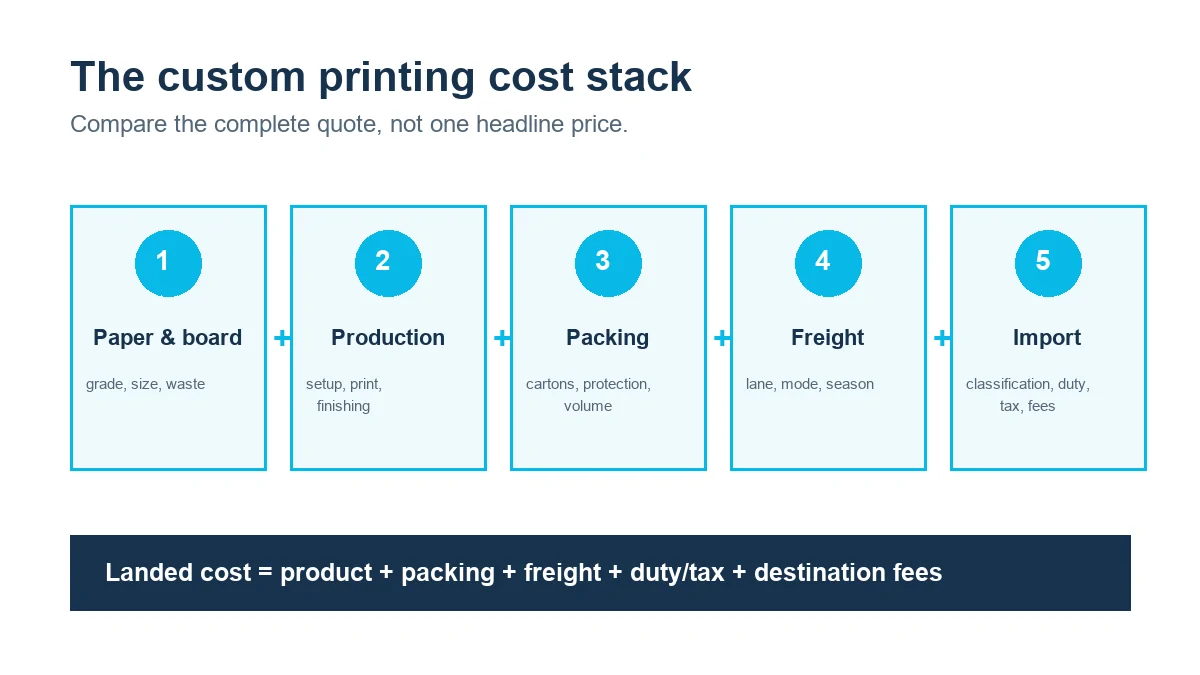
A custom print order has five connected cost layers:
- Paper and board: grade, weight, sheet size, waste and availability.
- Production: prepress, setup, printing, numbering, perforation, binding and inspection.
- Packing: units per carton, protective material, carton strength and total volume.
- Freight: route, mode, chargeable weight or volume, season and destination handling.
- Import: tariff classification, origin, customs value, duty, VAT or other taxes, and entry fees.
The U.S. International Trade Administration defines landed cost as the product price plus insurance, freight, tariffs, taxes and other fees. That is the correct comparison frame, but it is not a universal formula with one fixed tax rate. The contract must also say which party pays each item.
Paper and Board Signals
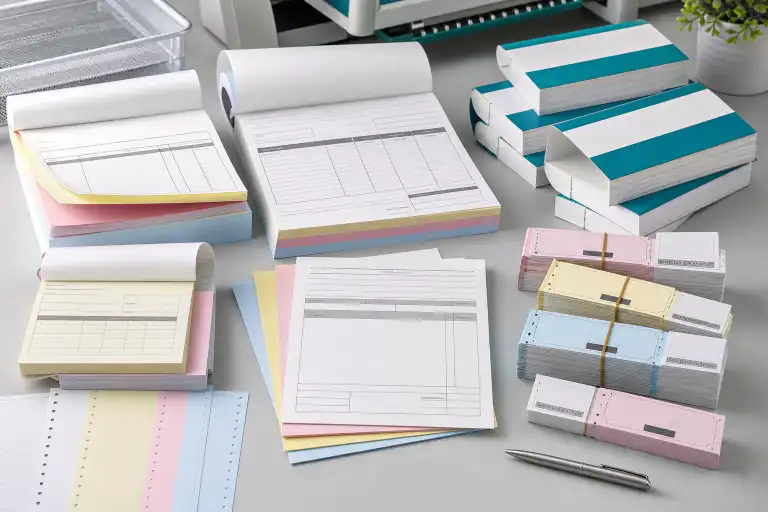
Paper is important, but a broad index cannot price a specific job. The August 2026 U.S. Producer Price Index showed paper down 0.3% year over year and paperboard up 2.3%. These series are useful directional signals, not quotations for NCR stock, notebook text paper, cover board or a specific mill grade.
A buyer should ask four job-level questions:
- Is the quoted stock the same grade, weight, color and finish as the previous order?
- Does the finished size impose unusual trimming or sheet waste?
- Is a cover, backing board or multipart construction included?
- Will a substitution change opacity, writing feel, transfer performance or durability?
This is where specification discipline creates value. A cheaper material that changes the product is not a comparable saving. For custom business forms, the part count, sheet colors and binding can matter more than a small movement in a general paper index.
Labor and Production
Printing remains a sequence of skilled operations even when presses are automated. Artwork review, prepress, setup, color control, numbering, finishing, inspection and packing all consume labor or machine time.
The BLS Employment Cost Index reported that total compensation for U.S. private-industry workers rose 3.3% over the year ending in the second quarter of 2026. That figure covers private industry broadly; it should not be treated as the wage increase at any particular printer. It does show why labor-sensitive stages cannot be assumed to stay flat.
The strongest way to manage this layer is to remove avoidable work rather than pressure a supplier to hide it. Supply final dimensions, confirm copy parts and colors, identify numbering and perforation positions, and approve a stable proof. Repeated artwork changes, ambiguous files and late packing revisions can create costs that a low headline unit price never reveals.
Freight Changes the Answer
Printed paper products are dense, and cartons can become heavy before they fill a pallet or container. Freight therefore changes with both mass and volume, plus the route and service level.
Drewry’s World Container Index was $4,476 per 40-foot container on September 10, 2026, unchanged for a second week. The global figure is a benchmark, not the rate for a specific shipment. Transpacific and Asia–Europe lanes can move in different directions, and a small order may travel by courier, air freight, less-than-container load or consolidated ocean service rather than a full container.
The August 2026 U.S. PPI also reported transportation and warehousing services up 2.3% year over year. Buyers should therefore request a dated freight basis and compare:
- shipping mode and named route;
- carton count, gross weight and dimensions;
- whether the quote is based on actual or volumetric weight;
- origin and destination charges;
- insurance and customs-clearance responsibility;
- validity period and expected handoff points.
Changing the finished size, units per carton or packaging protection can change freight without changing printing. A sensible supplier discussion includes the packing plan before the order is produced.
Duties, Tax and Fees
Do not apply one guessed percentage to every printed product. In the United States, the Harmonized Tariff Schedule classification and country of origin determine the duty treatment. CBP also states that formal entries can carry a Merchandise Processing Fee, and ocean imports through identified ports can carry a Harbor Maintenance Fee. Other measures may apply depending on the product and origin.
In the European Union, duty depends on tariff classification, customs value and origin. Import VAT is generally calculated on a base that can include the customs value, duties and incidental expenses such as transport and insurance to the first destination. VAT rates and procedures vary by member state.
Before ordering, give a customs broker or qualified adviser the actual product description, materials, use, country of origin, invoice value, packing and route. Ask who will act as importer of record and which trade term appears on the quotation. This article provides a budgeting framework, not tariff, tax or legal advice.
Where PrintingMaxx Helps
The useful advantage is not a claim that every overseas order is automatically cheaper. It is the ability to shape the order around the buyer’s real requirement before production.
PrintingMaxx’s current business-forms information supports low-MOQ ordering for first runs and repeats, plus review of a photo, scan or field list before proofing. That can help a small business avoid buying a larger run before a new form or layout has been tested. The same specification-led approach applies across custom business forms and custom printed business supplies.
For a useful comparison, send the same finished size, paper, colors, quantity, finishing and packing requirement to every supplier. PrintingMaxx can then review those details and prepare a quotation based on the requested construction. The final economic advantage must be demonstrated by the complete quote and delivered result—not assumed from geography or a unit price alone.
Reset a Reorder Quote
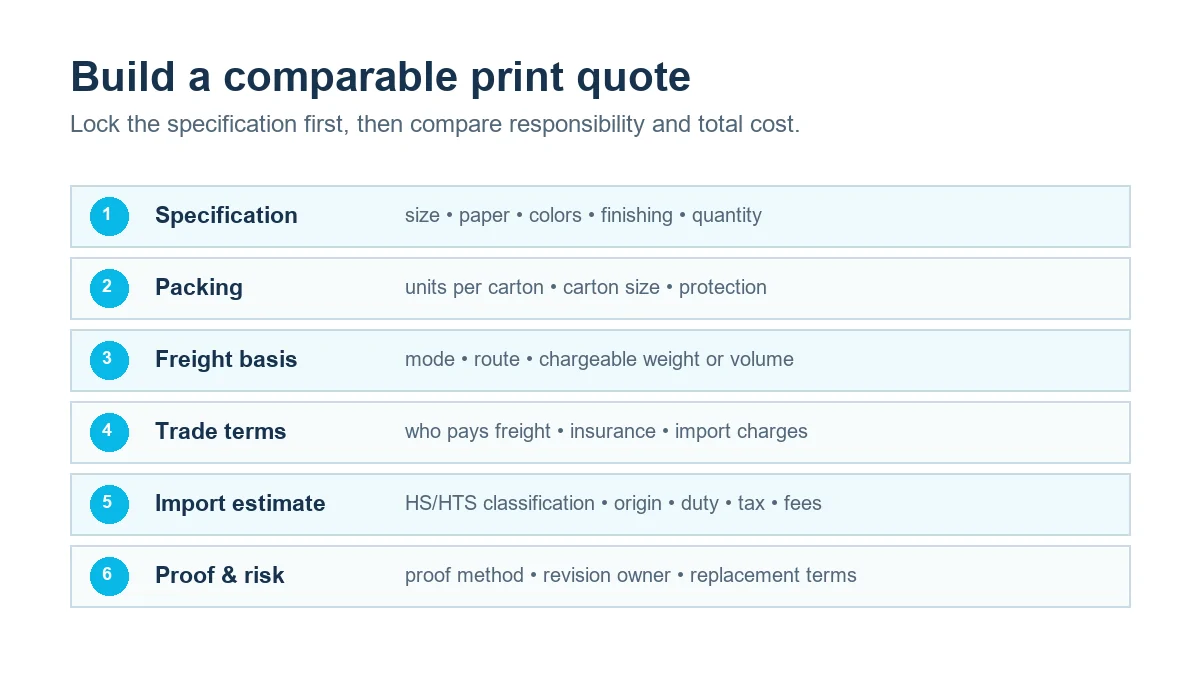
Use this checklist when a previous order is six months old, the delivery country has changed, or the product specification has been revised.
- Confirm the artwork version and finished dimensions.
- Confirm paper or board grade, weight, color and approved substitutes.
- List printing colors, numbering, perforation, binding and other finishing.
- State total quantity and units per book, pad, pack or carton.
- Request carton count, dimensions and gross weight.
- Name the shipping mode, destination and trade term.
- Ask which origin, destination, clearance and insurance charges are included.
- Obtain the expected classification and import estimate from a qualified broker.
- Compare the total delivered estimate, proof process and risk allocation.
If you are planning a new run, contact PrintingMaxx with the product, size, paper, quantity, finishing, delivery country and desired timing. A complete request produces a more useful comparison than “price per piece” alone.
Cost Questions
Are paper prices falling in 2026?
Not as one universal category. U.S. producer-price data for August 2026 showed paper down 0.3% year over year and paperboard up 2.3%. Your job may use a different grade, market or supplier, so request a current material basis.
Does a lower unit price mean a lower landed cost?
No. Packing, freight, duty, import tax, clearance and destination handling can change the delivered total. Compare the same specification and responsibility split.
Should I ask for DDP pricing?
Ask for the trade term that makes responsibilities clear and can be supported by the supplier and logistics partners. Do not compare a delivered quote with an origin-only quote without adding the missing costs.
How long should a print quote remain valid?
Use the validity stated by the supplier. Material and freight bases can change, so refresh a quote when the validity expires, the route changes or the specification is revised.
Sources
- U.S. Bureau of Labor Statistics: Producer Price Index, August 2026
- U.S. Bureau of Labor Statistics: Employment Cost Index, Q2 2026
- Drewry World Container Index, September 10, 2026
- U.S. CBP: duty, taxes and fees
- European Commission: calculation of customs duties
- European Commission: import VAT taxable amount
- U.S. International Trade Administration: determine total export price